Core Elements of Modern employee wellbeing strategies
To build a truly resilient organization in April 2026, we must look beyond the surface level of "perks." Modern employee wellbeing strategies are rooted in the understanding that health is holistic. It isn't just about the absence of…

To build a truly resilient organization in April 2026, we must look beyond the surface level of "perks." Modern employee wellbeing strategies are rooted in the understanding that health is holistic. It isn't just about the absence of illness; it’s about the presence of fulfillment.
When we design Employee Health and Wellbeing Initiatives, we must consider the interconnectedness of an individual's life. If an employee is physically fit but drowning in financial stress, or if they are socially connected but feel their career is a dead end, their overall wellbeing will suffer.
A powerful framework often used to guide these efforts is the Surgeon General’s Framework for Workplace Mental Health and Well-Being. This framework identifies five essentials:
- Protection from Harm: Prioritizing physical and psychological safety.
- Connection & Community: Fostering positive social interactions and a sense of belonging.
- Work-Life Harmony: Respecting boundaries and providing autonomy.
- Mattering at Work: Ensuring employees feel valued and connected to the mission.
- Opportunity for Growth: Providing pathways for learning and advancement.
By aligning our strategies with these human needs, we create an environment where people don't just survive the work week—they thrive within it. You can explore the Scientific research on the Surgeon General’s Framework for Workplace Mental Health to see how these elements create a foundation for organizational health.
Why Prioritizing employee wellbeing strategies is a Business Imperative
Some leaders still view wellbeing as a "nice-to-have" HR initiative. However, the data proves that Employee Wellness and Productivity are inextricably linked. Neglecting this area is a massive financial risk. For every 10,000 employees, organizations lose roughly $20 million in lost opportunity due to low wellbeing.
The benefits of a proactive strategy are undeniable:
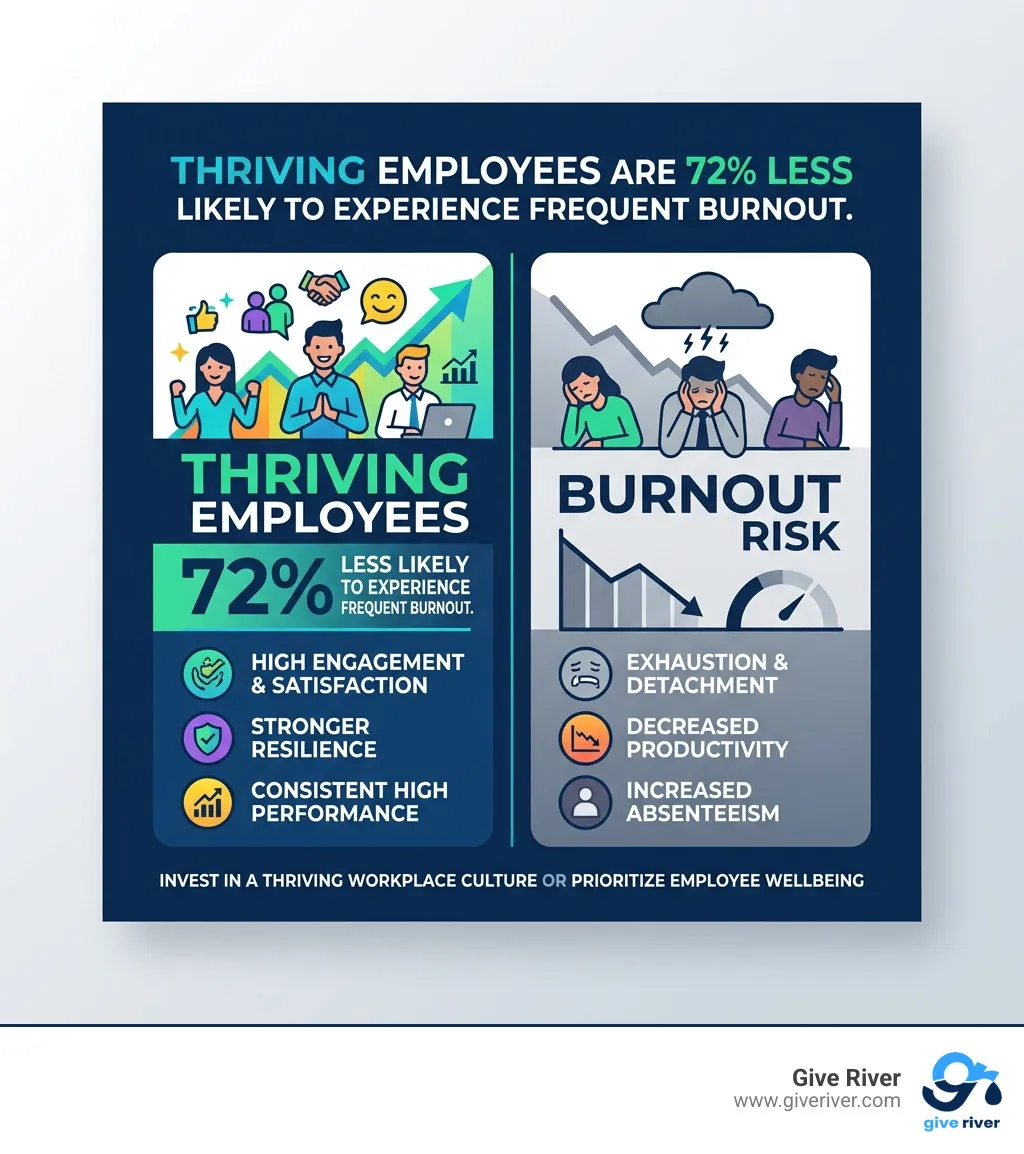
- Burnout Reduction: Employees who feel their organization cares about their wellbeing are 72% less likely to experience frequent burnout.
- Retention: Thriving employees are 49% less likely to be actively seeking a new job. Given that burned-out employees are 2.6 times more likely to leave, wellbeing is your best retention tool.
- Engagement: There is a "hidden risk" zone where employees are engaged but not thriving. These individuals are productive in the short term but carry a 61% higher risk of burnout. Wellbeing sustains engagement over the long haul.
Furthermore, fostering Scientific research on work-related stress and mental health through psychological safety allows for greater innovation. When people feel safe and supported, they take the creative risks necessary for business growth.
Beyond Physical Health: The 5 Dimensions of Wellbeing
To move from a basic wellness plan to a comprehensive strategy, we use the five dimensions of wellbeing. This is a Workplace Wellness Ultimate Guide approach that treats the employee as a whole person.
- Career Wellbeing: This is the foundation. It’s about liking what you do every day. Organizations influence this by using strengths-based work design—letting people do what they are best at.
- Social Wellbeing: We are social creatures. Meaningful connections and supportive relationships at work act as a buffer against stress.
- Financial Wellbeing: Economic stability is a major stressor. Offering Financial Wellness Education helps employees manage their economic lives, reducing the mental "noise" that distracts from work.
- Physical Wellbeing: Having the energy to get things done. This includes sleep, nutrition, and movement.
- Community Wellbeing: The sense of engagement you have with the area where you live and work. This is where giving back and Charitable Impact play a massive role in providing a sense of purpose.
Implementing and Measuring Your Wellbeing Initiatives

Implementation is where many employee wellbeing strategies stumble. It’s not enough to announce a program; it must be woven into the cultural fabric. This requires heavy leadership buy-in. If executives aren't modeling healthy boundaries—like not sending emails at 9 PM—employees won't feel safe doing the same.
Following Employee Wellness Best Practices means moving away from one-size-fits-all solutions. We recommend an inclusive design process: survey your workforce, identify their specific stressors, and build programs that solve their problems. Whether it's better healthcare access or more predictable scheduling, the solution must match the need. You can find more structured ideas in our guide on Workplace Health and Wellness Programs.
Innovative employee wellbeing strategies for 2026
As we navigate 2026, the most successful companies are moving toward high-flexibility and high-support models. Here are some Workplace Wellness Program Ideas that are moving the needle:
- Radical Flexibility: Employees with control over their schedule and location are 41% more engaged and 71% more likely to stay.
- Mindfulness and Mental Health Days: Normalizing mental health care by providing dedicated "recharge" days and confidential counseling.
- Gamified Fitness Challenges: Using friendly competition to encourage movement and team bonding.
- Nutrition Workshops: Bringing in experts to help employees fuel their bodies for sustained energy.
While platforms like Bonusly or Kudos offer great ways to send quick digital "props," they often lack the holistic depth needed for long-term health. Give River differentiates itself by moving beyond transactional recognition to integrate professional growth and community impact, ensuring wellbeing is a core cultural value rather than just a series of notifications. Check out more Employee Wellness Activities to keep your team energized.
The Manager’s Role in Fostering a Thriving Culture
Managers account for the majority of the variance in team engagement and wellbeing. In many ways, the manager is the Wellness in the Workplace strategy.
When managers fail to recognize their team's efforts, the odds of burnout increase by 48%. To counter this, managers should be trained as performance coaches who:
- Hold frequent, meaningful conversations: Move beyond "status updates" to ask how people are actually doing.
- Clarify priorities: High stress often comes from "priority overload." Managers must help employees filter what truly matters.
- Recognize contributions: Frequent, specific praise for both results and effort builds a culture of gratitude.
- Support the whole person: Acknowledging that employees have lives, families, and challenges outside of the office.
Utilizing Employee Wellness Software can help managers track these touchpoints and ensure no one on the team is slipping into the "Suffering" category.
Measuring Success and Avoiding Common Pitfalls
You cannot manage what you do not measure. However, only 17% of organizations currently measure the effectiveness of their mental health and wellbeing programs. To avoid "wellness washing"—the practice of offering perks that don't actually improve lives—you need data.
We recommend using the Life Evaluation Index. This categorizes employees into three groups:
- Thriving: Strong, consistent, and progressing.
- Struggling: Moderate or inconsistent stress; at risk of burnout.
- Suffering: High risk; likely experiencing significant physical or mental health challenges.
By using Wellness Platforms Anonymized Employee Health Data Reporting, you can see trends without violating privacy. This allows you to adjust your strategy in real-time. For a deeper dive into the tech side, see our Integrated Wellness Platform Ultimate Guide.
Sustaining Long-Term Impact with Give River
At Give River, we know that the most effective employee wellbeing strategies are those that make growth and gratitude a daily habit. While competitors like Bonusly or Kudos excel at peer-to-peer shoutouts, Give River provides Corporate Wellbeing Solutions that go beyond the traditional "wellness app" by connecting individual recognition to broader personal development and charitable purpose.
Our unique 5G Method is designed to build high-performing, healthy teams:
- Guided: Structured paths for personal and professional development.
- Gamified: Making wellbeing and recognition fun and engaging.
- Gratitude: A systematic way to ensure every employee feels seen and valued.
- Growth: Content that supports both career and personal vitality.
- Generosity: Connecting work to a larger purpose through community impact.
By integrating Personalized Wellness Plans with the ability to drive Charitable Impact, we help you create a workplace where employees feel they truly matter. When your team thrives, your business thrives. Let's build a culture where wellbeing isn't just a program—it's your competitive advantage.
More from this category.

Importance of Workplace Health and Wellness Programs
Workplace health and wellness programs are an essential element in fostering a supportive and productive workplace culture. These programs can significantly improve employee wellness, improve job satisfaction, and reduce turnover. A…

The Connection Between Employee Wellness and Productivity
When it comes to enhancing both employee wellness and productivity, the link between well-being and efficient work environments is undeniable. At the heart of this relationship are three core benefits:

Why Virtual Wellness Challenges Are Essential for Modern Remote Teams
Virtual wellness challenge ideas are changing how companies support employee well-being in our increasingly remote work landscape. With 80% of employees experiencing stress at work and remote workers facing unique challenges like isolation…
See the platform in action.
Free for up to 25 members, or try Core or Growth free for 30 days. A card is required; Free is never charged, and a trial bills when it ends unless you cancel.