Why Cheer Team Bonding Exercises Are the Foundation of Every Great Squad
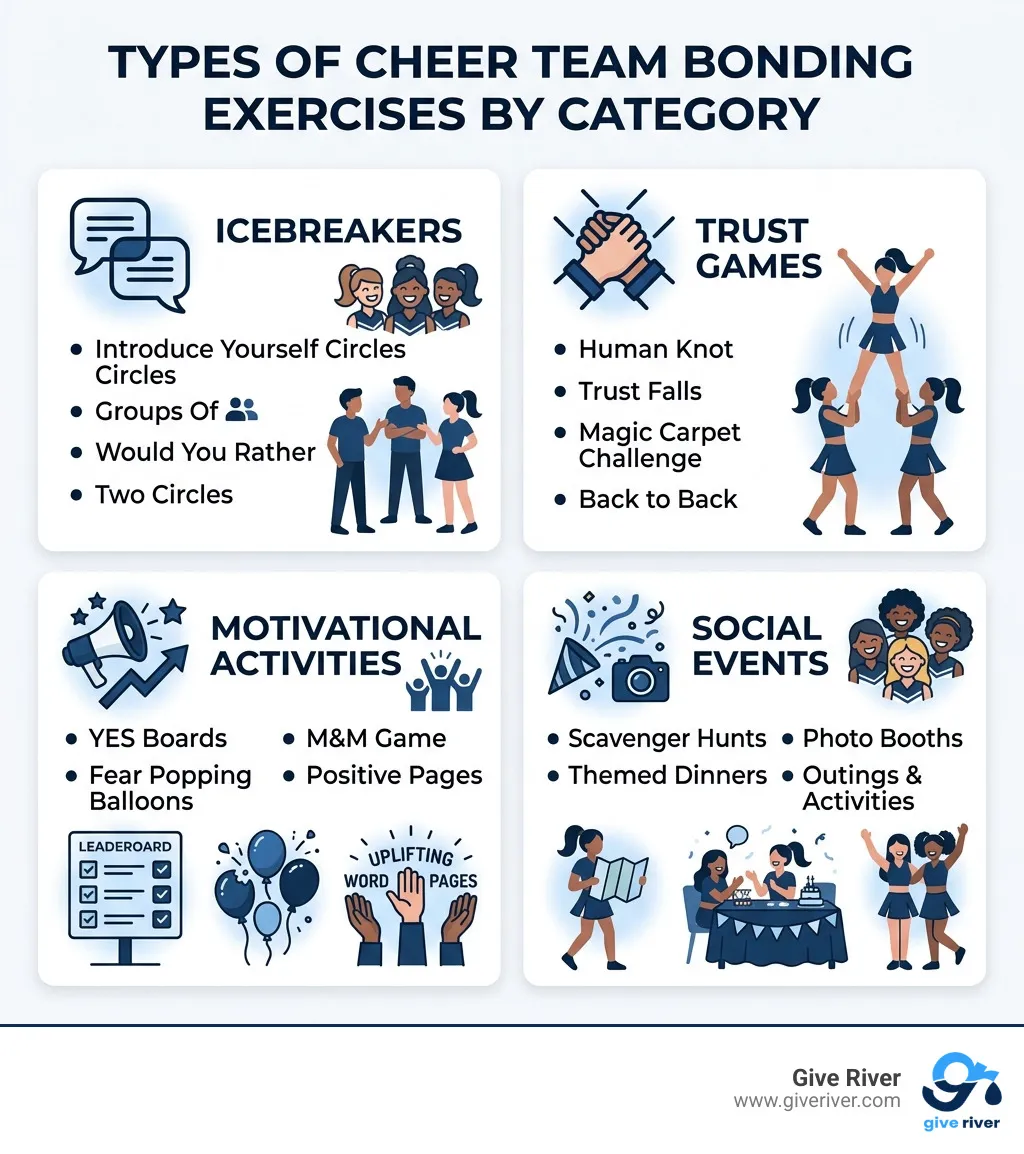
Cheer team bonding exercises are structured activities designed to build trust, improve communication, and strengthen the relationships that make a squad perform as one. Here are the most effective types to get you started:
Cheer team bonding exercises are structured activities designed to build trust, improve communication, and strengthen the relationships that make a squad perform as one. Here are the most effective types to get you started:
- Icebreakers - Introduce Yourself circles, Groups Of, Would You Rather, Two Circles
- Trust-building games - Human Knot, Trust Falls, Magic Carpet Challenge, Back to Back
- Motivational activities - YES boards, Fear Popping balloons, M&M Game, Positive Pages
- Creative connection - Pillowcase messages, team goal boards, encouraging note booklets
- Social events - Scavenger hunts, foam parties, themed dinners, photo booths
- Camp-specific ideas - Morning messages, dress-up days, mascot awards, clothespin pinning
Cheerleading is unlike most team sports. Flyers literally put their lives in the hands of their bases. That level of physical trust doesn't develop by accident — it's built deliberately, one shared experience at a time.
Yet many squads treat bonding as an afterthought, reserving it for the occasional pizza party or bowling night. The research tells a different story. Teams that engage in intentional bonding exercises show stronger communication, deeper cooperation, and measurably better performance under pressure — all qualities that translate directly to safer stunts and sharper routines.
The good news? Building that foundation doesn't require a big budget or a lot of time. Even five minutes at the start of practice, done consistently, can shift the entire dynamic of a squad. Whether your team is brand new or a returning group looking to gel faster this season, the right exercises make all the difference.
I'm Meghan Calhoun, co-founder of Give River and a two-decade veteran of high-performance team environments, and I've seen how the same principles that drive cheer team bonding exercises — gratitude, connection, shared purpose, and growth — are the exact ingredients that make any team, on or off the mat, truly unstoppable. The strategies in this guide are grounded in that experience, and they're ready to put to work at your next practice.
Learn more about cheer team bonding exercises:
Essential Cheer Team Bonding Exercises for Trust and Unity
Building a cohesive cheer squad is about more than just hitting a perfect stunt; it’s about the invisible threads of trust that connect every member. In April 2026, as we look at the evolving landscape of youth sports, the need for emotional safety is just as high as the need for physical safety. When teammates feel a sense of belonging, they are more likely to push through the fatigue of a long practice or the nerves of a major competition.
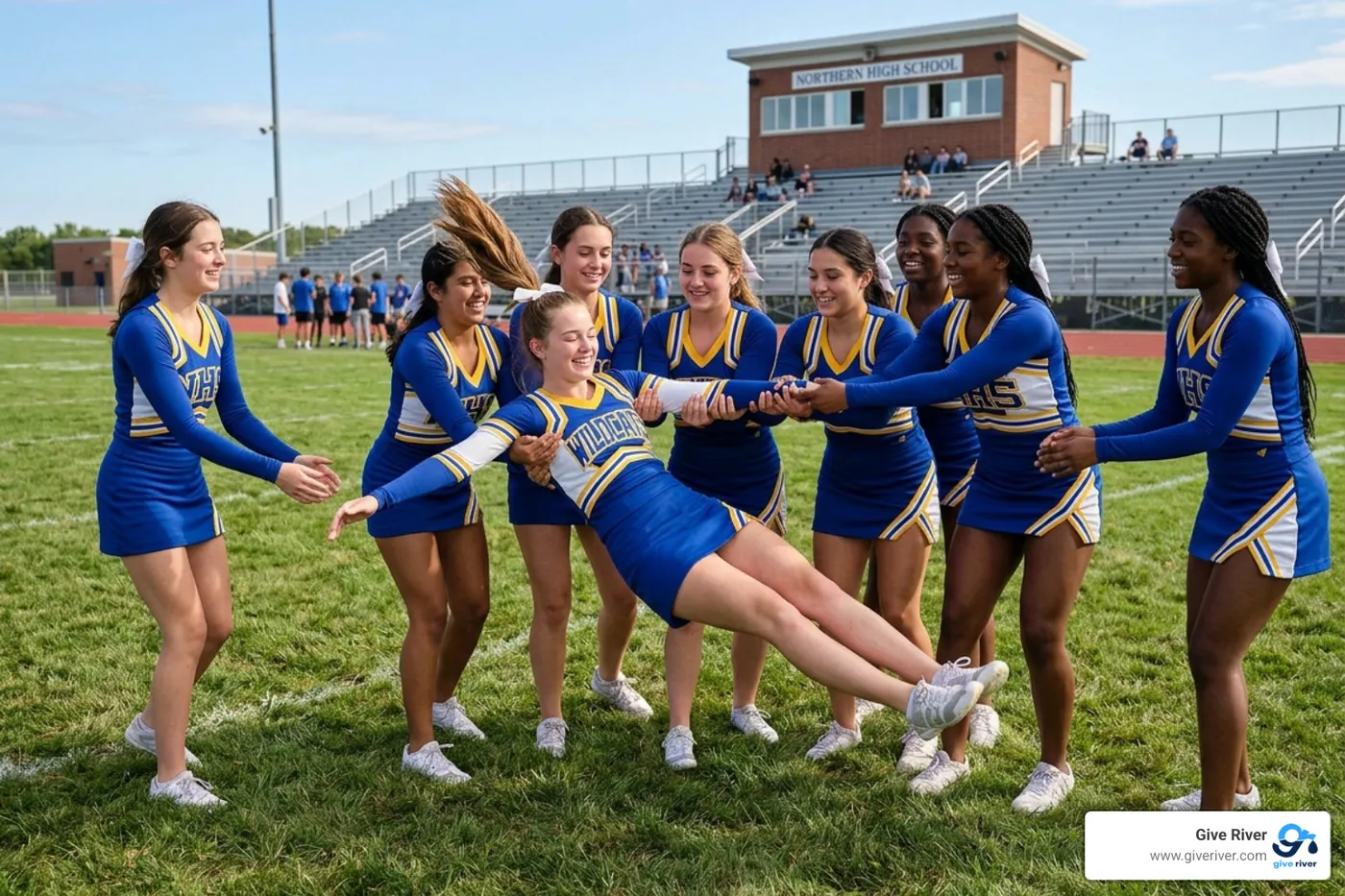
Trust and unity are the "glue" of any high-performing team. In cheerleading, this is particularly evident during stunts. If a base doesn't trust their backspot, or a flyer is hesitant to lean into their cradle, the entire routine suffers. By incorporating active team bonding exercises, coaches can break down social barriers and encourage problem-solving in a low-stakes environment. This ensures that when the pressure is on, the team reacts as a single, unified organism rather than a collection of individuals.
High-Energy Icebreakers and Cheer Team Bonding Exercises
The first practice of the season can be intimidating, especially for new members. High-energy icebreakers are essential for melting away those initial nerves. A great way to start is the "Introduce Yourself" circle. Instead of just sharing names, ask athletes to share one "boring" fact about themselves. This often results in more laughs and connection than "fun" facts because it removes the pressure to sound impressive.
Another effective game is "Groups Of." The coach calls out a category, such as "favorite fast-food restaurant" or "number of siblings," and the cheerleaders must quickly find others who share that trait. Once they form a group, give them one minute to discuss a specific detail—like their go-to order. This encourages athletes to talk about things other than cheer, building a more well-rounded friendship.
For a bit of movement, try "Would You Rather." Designate one side of the gym for option A and the other for option B. As you call out prompts, athletes walk to their chosen side and chat with the people there about why they made that choice. These easy team bonding games are quick, require no equipment, and can be done in the first ten minutes of any practice.
Classic Trust-Building Games for Stunt Success
Once the ice is broken, it’s time to move into deeper trust-building. Classic games like the Human Knot are staples for a reason. They require intense communication and physical proximity—two things cheerleaders must be comfortable with. To play, the team stands in a circle, reaches in, and grabs the hands of two different people (not the person directly next to them). They then have to untangle themselves without letting go.
Trust Falls are perhaps the most iconic of all cheer team bonding exercises. While they might seem cliché, they are highly effective for squads that rely on physical catching. For a variation, try the "Trust Circle." One athlete stands in the center of a tight circle with their eyes closed and arms crossed. They lean in any direction, and the surrounding teammates gently catch and pass them around the circle. This reinforces the idea that the team is always there to catch you.
Finally, the Magic Carpet Challenge involves the whole team standing on a small tarp or "carpet." They must flip the carpet over without any member stepping off onto the floor. This requires a high level of coordination and physical reliance. Research in sports psychology suggests that these types of cooperative challenges increase team productivity and boost commitment levels because they require every person to contribute to a shared goal. You can find more structured ideas in our good team bonding exercises guide.
Creative and Motivational Cheer Team Bonding Exercises
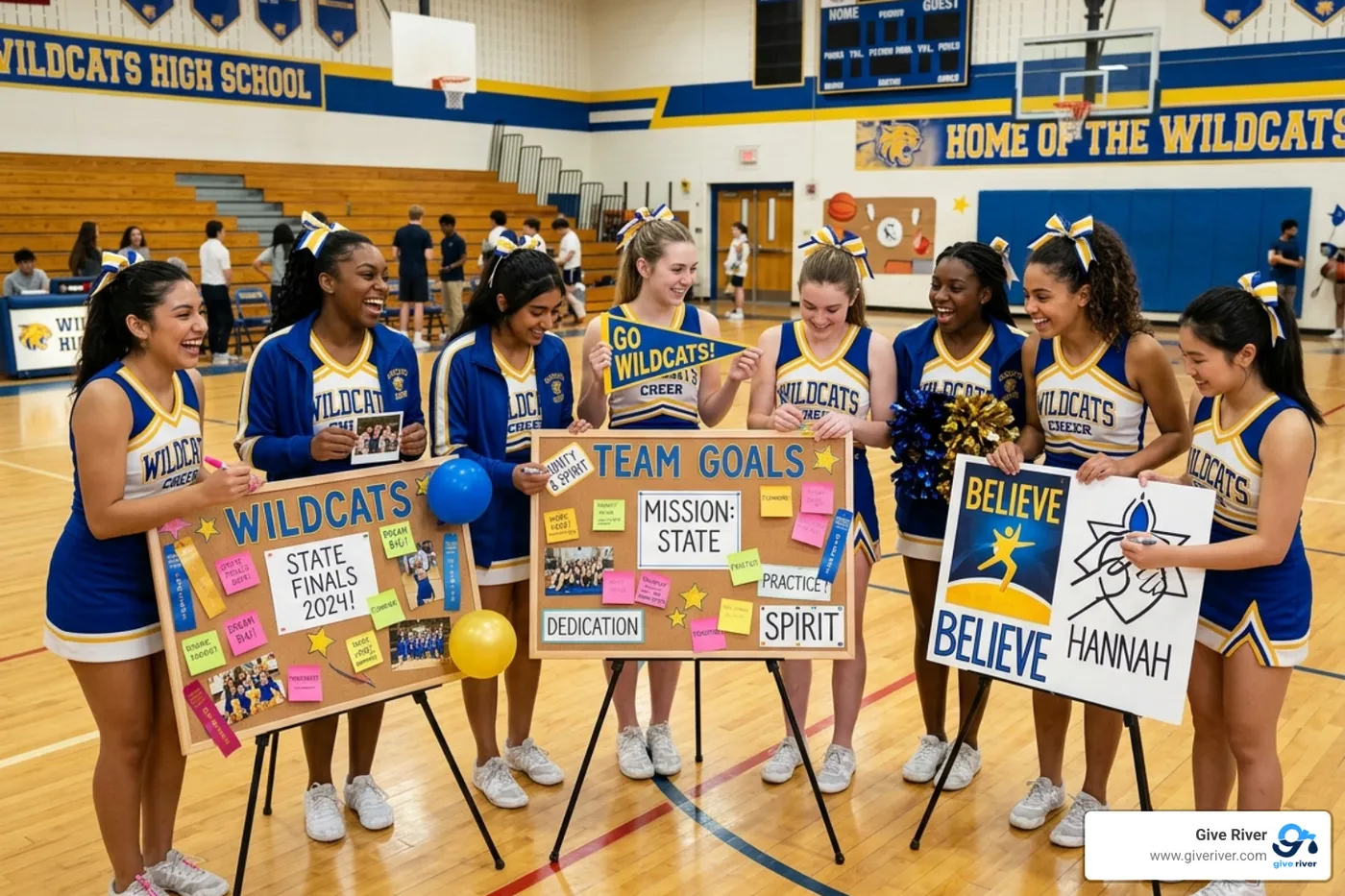
Motivation is the fuel that keeps a team going through the grueling mid-season slump. Creative activities like Positive Pages or YES boards create a permanent record of the team's support for one another. For Positive Pages, each member tapes a piece of paper to their back. Teammates then walk around and write one positive adjective or encouraging note on each person's paper. It’s a powerful way to boost self-esteem and ensure every athlete feels valued.
For a more symbolic release, try Fear Popping. Have each cheerleader write a specific fear or insecurity on a balloon. After a brief discussion about how these fears hold the team back, everyone takes their balloon outside and pops it, symbolically letting go of those weights.
The M&M Game is another favorite. Pass around a bag of M&Ms and have each person take a few. For every color they have, they must answer a specific prompt:
- Red: A personal goal for the season.
- Blue: Something you admire about the person to your left.
- Green: A challenge you’ve overcome.
- Yellow: Your favorite cheer memory.
These team building activities foster deeper emotional connections, which are just as important as physical trust.
Implementing Long-Term Bonding Strategies Beyond the Mat
Bonding shouldn't stop when the practice clock runs out. In fact, some of the most profound connections happen when the athletes are away from the mats and the pressure of performance. Long-term strategies involve creating a "team culture" that exists in the real world.
Integrating social events, themed practices, and community service into your calendar helps the squad see themselves as a family. When a team works together on a fundraising project or volunteers at a local food bank, they bond over shared values and a sense of purpose. This "off-mat" unity translates to better on-field coordination because the athletes genuinely care about one another's success. For more ideas on how to structure these sessions, check out our indoor team bonding exercises guide.
Non-Practice Socials and Seasonal Events
Socializing outside of the gym is where the real "magic" happens. Slumber parties and themed dinners (like a "Black Tie Pancake" night) allow cheerleaders to relax and be themselves. For a higher-energy event, consider a foam party or a scavenger hunt at a local mall. Scavenger hunts are particularly great because they require teams to work together under a time limit to solve riddles and complete challenges.
Seasonal events are also perfect for maintaining momentum. In the fall, a trip to a corn maze or a pumpkin painting party keeps the spirit high. In the winter, an "Ugly Sweater" exchange or a hot chocolate bar can provide a much-needed break from competition stress. For teams that might be geographically separated or during the off-season, you can even use a virtual group activities team building guide to keep the connection alive via Zoom.
Deep Connection and Goal-Setting Activities
As the season progresses, it’s important to move from "fun and games" to deeper connection. Question jars are a simple tool for this. During water breaks or at the end of practice, pull a question from the jar. These can range from lighthearted ("What’s your favorite holiday?") to deep ("Who has most influenced your life?").
Sharing personal goals and fears is another way to build a "sturdy foundation." When athletes know what their teammates are working toward, they can offer specific encouragement. Scientific research has shown that social support is a major predictor of athletic performance and resilience. When an athlete feels supported by their peers, they are more likely to recover quickly from mistakes and stay motivated. This is the heart of our team bonding exercise ultimate guide.
Adapting Bonding for Every Squad Level
Not every exercise works for every team. A group of six-year-old "Tiny" cheerleaders will have different needs than a collegiate squad. For younger kids, keep games short, physical, and focused on simple cooperation, like "Balloon Stomp" or "Head, Shoulders, Knees, Cup." For older athletes, focus on activities that allow for vulnerability and complex problem-solving.
Safety and inclusivity should always be the priority. Ensure that every activity can be modified for different physical abilities and that no one is ever forced into a situation that makes them feel truly unsafe or excluded.
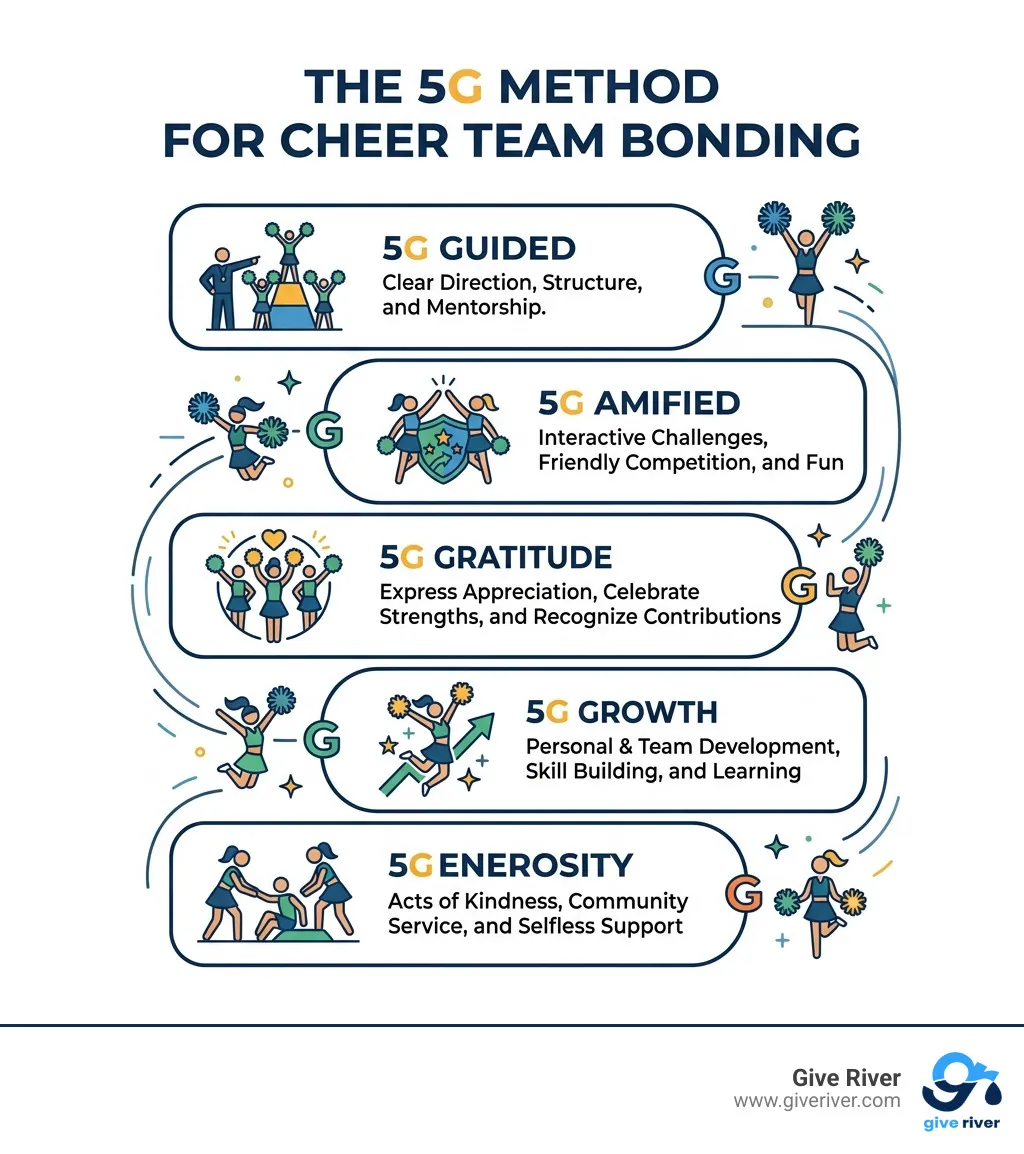
In the landscape of team engagement, platforms like Bonusly and Kudos are well-known for facilitating peer-to-peer recognition. While these tools are effective for corporate environments, they often focus on transactional rewards. At Give River, we differentiate ourselves by going deeper with our 5G Method. We believe that by integrating Gratitude, Guidance, Gamification, Growth, and Generosity, you can transform any group into a high-performing family. Unlike standard recognition platforms, Give River is designed to foster the emotional safety and character-driven unity essential for the high-trust environment of a cheer squad. Whether you are using a digital platform or physical cheer team bonding exercises, the goal is the same: to make every member feel seen, valued, and essential to the team's success.
If you're ready to take your squad's unity to the next level, explore our team building solutions and start building your foundation today.
Conclusion
Building a sturdy cheer team foundation isn't a one-time event; it's a season-long commitment to connection. By mixing high-energy icebreakers, classic trust games, and deep motivational activities, you create a squad that isn't just talented, but truly unified.
The most successful teams are those where athletes feel safe to fail, supported to grow, and empowered to lead. Whether you're at cheer camp or in the middle of a high-stakes practice, take those five minutes to bond. Those small moments of laughter and shared vulnerability are what turn a group of cheerleaders into a family. Let's make this season the most connected one yet!
More from this category.

Best Gamified Employee Engagement Platforms (2026)
Six engagement platforms compared on leaderboards, challenges, and campaigns, from their own sites, plus how to gamify engagement without making it childish.

Why the Best Team Meeting Ice Breakers Are Worth Every Minute
The best team meeting ice breakers can be the difference between a room full of disengaged faces and a team that's genuinely ready to collaborate. Whether you're running a daily standup, a new-hire kickoff, or a large all-hands, how you…

Why Remote Teams Are Refinding the Magic of Classic Game Shows
Family feud virtual team building is a powerful way to combat remote work isolation and rebuild team connections. With 73% of remote workers feeling lonely, teams need more than another Zoom meeting - they need shared experiences that…
See the platform in action.
Free for up to 25 members, or try Core or Growth free for 30 days. A card is required; Free is never charged, and a trial bills when it ends unless you cancel.