Why Most Companies Are Losing Talent They Could Easily Keep
Employee recognition methods are the structured and spontaneous ways organizations acknowledge their people's contributions — and getting them right is one of the highest-leverage moves a company can make.

Employee recognition methods are the structured and spontaneous ways organizations acknowledge their people's contributions — and getting them right is one of the highest-leverage moves a company can make.
Here's a quick-reference breakdown of the most effective approaches:
| Recognition Method | Type | Frequency | Best For |
|---|---|---|---|
| Manager shout-outs | Informal | Daily / Weekly | Reinforcing specific behaviors |
| Peer-to-peer kudos | Peer-led | Ongoing | Building team connection |
| Values-based awards | Formal | Monthly / Quarterly | Aligning culture with behavior |
| Milestone celebrations | Formal | As they occur | Loyalty and life moments |
| Surprise time off | Informal | Spontaneous | Immediate morale boost |
| Handwritten notes | Informal | Anytime | Personal, high-impact appreciation |
| Public shout-outs (all-hands) | Formal / Informal | Weekly / Monthly | Visibility and inspiration |
| Micro-learning rewards | Growth-linked | Ongoing | Development-driven recognition |
Here's a number that should stop any HR leader cold: only one in three employees in the U.S. strongly agree they received recognition or praise for doing good work in the past seven days. And the cost of that silence? Employees who don't feel adequately recognized are twice as likely to say they're planning to leave within the year.
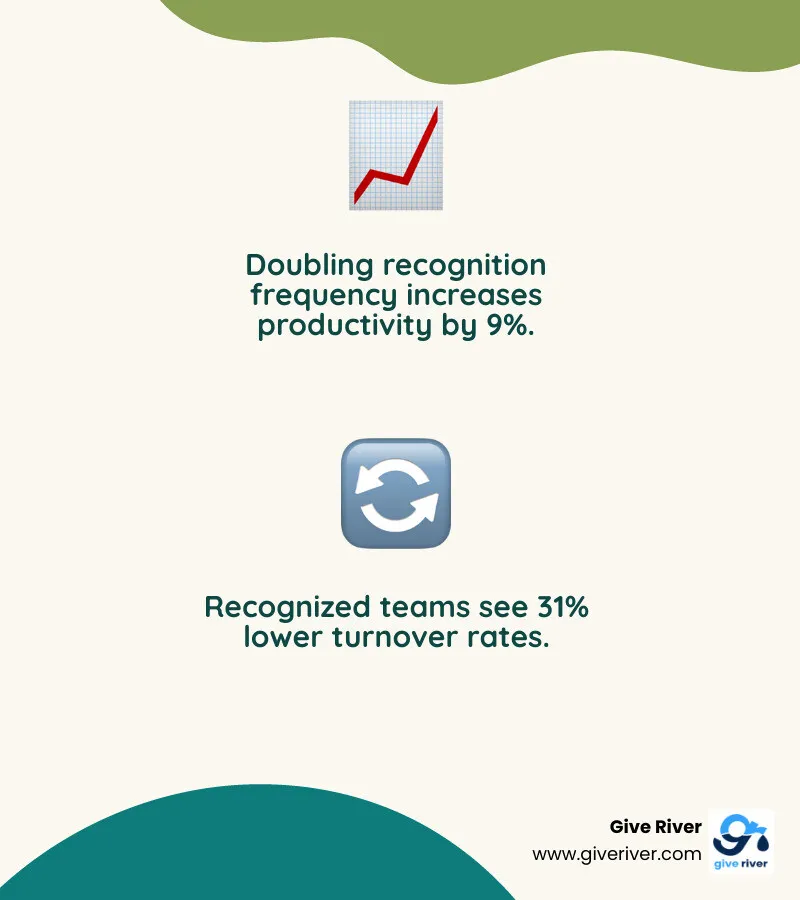
Yet the fix doesn't require a massive budget overhaul. Research shows that simply doubling the frequency of meaningful recognition can produce a 9% increase in productivity, a 22% drop in absenteeism, and a 31% reduction in turnover. The gap between struggling and thriving teams often isn't compensation — it's whether people feel seen.
The challenge for most mid-sized organizations isn't awareness. Leaders generally understand that recognition matters. The real problem is structure — recognition happens sporadically, flows in only one direction, and rarely ties back to the behaviors that actually move the business forward. That's the gap this guide is designed to close.
I'm Meghan Calhoun, Co-Founder of Give River, and after two decades leading high-pressure sales teams — including work that required me to support grieving families through some of the hardest moments of their lives — I've seen how employee recognition methods can either drain or energize a team. That experience shaped everything we've built at Give River, and everything you'll find in this guide.
Easy employee recognition methods word list:
The Science and Strategy of Modern Employee Recognition Methods
Effective recognition isn't just "nice to have"; it’s biologically essential. When we receive a sincere "thank you" or public acknowledgment, our brains release dopamine, the "feel-good" neurotransmitter associated with rewards and motivation.
In the workplace, we often look at the SCARF model (Status, Certainty, Autonomy, Relatedness, Fairness). Recognition directly hits the Status and Relatedness triggers. When an employee is recognized, their social status within the group rises, and their sense of belonging (relatedness) deepens. This creates an emotional connection to the company that a simple paycheck cannot replicate.
While monetary rewards are transactional, employee recognition methods are relational. A bonus is forgotten once the bills are paid, but the "glow" of being publicly praised by a CEO or a peer can last for months. To build a sustainable culture, we must distinguish between different types of appreciation:
| Type | Description | Example |
|---|---|---|
| Formal | Structured, scheduled, and often high-level. | "Employee of the Month" or Annual Awards. |
| Informal | Spontaneous but specific gestures from leadership. | A personalized email or a shout-out in a Slack channel. |
| Everyday | Low-barrier, high-frequency micro-moments. | A "high-five" at the end of a shift or a desk sticky note. |
Why Recognition is the Engine of Employee Engagement
According to McKinsey research on the power of non-financial motivators, non-financial incentives like praise from an immediate manager can be more effective than cash bonuses. In fact, up to 55% of employee engagement is driven by non-financial recognition.
The business case is undeniable. Well-recognized employees are 45% less likely to leave the company after two years. Furthermore, organizations with robust employee recognition strategies see a 14% increase in engagement, productivity, and performance. By acknowledging effort, we prevent the "quiet quitting" and burnout that stems from feeling like a cog in a machine.
Core Characteristics of Effective Employee Recognition Methods
Not all praise is created equal. To move the needle, your employee recognition methods must follow these five gold standards:
- Timely: Recognition should happen as close to the event as possible. Waiting for an annual review to say "good job" on a project from six months ago feels irrelevant.
- Specific: Avoid generic "thanks for your hard work." Instead, say, "Thank you for staying late on Tuesday to ensure the client presentation was perfect; your attention to detail saved the account."
- Inclusive: Every role, from the frontline to the back office, should have a path to being seen.
- Values-Aligned: Tie praise to your company values. This makes your culture actionable rather than just words on a lobby wall.
- Visible: While some introverts prefer private thanks, public visibility allows the whole team to see "what success looks like."
For more practical ways to implement these, check out our employee recognition tips workplace guide.
Designing a Scalable Employee Recognition Solution
As teams grow, manual "thank yous" often fall through the cracks. This is where a structured employee recognition solution becomes vital.
The industry benchmark for a recognition budget is typically 1-2% of total payroll. While that might sound like a lot, compare it to the cost of turnover, which can range from 30% to 200% of an employee's salary. A scalable program ensures manager accountability—setting expectations that every leader should provide at least one specific recognition act per direct report per month.

Practical Frameworks for Implementing Recognition Across Your Organization
In May 2026, the workforce is more fragmented than ever. With hybrid and remote models being the standard, we can't rely on "watercooler moments" for appreciation. We need to hard-code gratitude into our digital workflows.
Creative and Low-Cost Employee Recognition Methods for Every Team
You don't need a massive vault of cash to make people feel valued. Some of the most memorable employee recognition methods cost nothing but a few minutes of time:
- Peer Shout-Outs: Create a dedicated "Wins" channel in Slack or Teams. When peers recognize each other, trust levels can skyrocket—research shows mutual recognizers have a trust rate 20 times higher than those who don't participate. You can learn more in our peer to peer recognition software complete guide.
- Surprise Time-Off: "Summer Fridays" or a "Wellness Wednesday" afternoon off can do wonders for morale.
- Professional Development: Offering a seat at a high-level meeting or a micro-grant for a certification shows you value their future, not just their current output.
- The "Traveling Trophy": A silly desk item (like a stuffed animal or a branded trophy) that gets passed from one high-performer to another each week.
For a deeper dive into these tactics, browse our employee recognition examples.
Overcoming Common Pitfalls in Recognition Programs
Even with the best intentions, programs can fail. The most common "culture killers" include:
- Top-Performer Bias: If the same three people win every award, the rest of the team disengages. Ensure you have tracks for "Innovation," "Collaboration," and "Customer Impact" to catch different types of excellence.
- Inconsistent Execution: Recognition that feels like a "flavor of the month" loses its sincerity.
- Software vs. Soul: While platforms like Bonusly or Kudos are excellent for managing points and rewards, they can sometimes feel transactional. Give River differs by prioritizing the emotional impact and long-term growth of the employee, ensuring that software is the vehicle, but genuine appreciation is the fuel.
To ensure your program lasts, follow modern employee recognition programs best practices, which emphasize measuring ROI through participation rates and engagement surveys rather than just nomination volume.
Conclusion: Building a Culture of Gratitude with Give River
At Give River, we believe that recognition is the heartbeat of a winning culture. While platforms like Bonusly or Kudos focus on peer-to-peer point systems, Give River offers a deeper transformation through our 5G Method: Guided, Gamified, Gratitude, Growth, and Generosity.
By integrating recognition with personal wellness and professional growth, we help you move beyond "engagement" and toward true fulfillment. When your team feels seen, supported, and connected to a larger purpose, they don't just work harder—they stay longer and perform better.
Ready to transform your workplace? Explore the Give River employee recognition solution and start building a culture where every win, no matter how small, is celebrated.
More from this category.
Best Employee Recognition Software for Nonprofits (2026)
What nonprofits need from recognition software, what six platforms charge mission-driven teams, and how to get a grant-funded Season of Give River for free.

Employee Recognition Software Pricing in 2026: What 6 Platforms Charge
What Give River, Bonusly, Motivosity, Nectar, Awardco, and Workhuman charge in 2026, from their own sites: pricing models, minimums, fees, and contract terms.

How to Improve Employee Recognition Across Multiple Locations
Six practical ways to make recognition reach every site and shift, what to look for in a platform, and how a 25-location nonprofit did it.
See the platform in action.
Free for up to 25 members, or try Core or Growth free for 30 days. A card is required; Free is never charged, and a trial bills when it ends unless you cancel.