Why Your Reward System Is Only as Strong as the Training Behind It
A well-designed training performance appraisal and reward system is one of the most powerful levers you have for driving employee engagement — but most organizations are only pulling one or two parts of it, and wondering why results fall…

A well-designed training performance appraisal and reward system is one of the most powerful levers you have for driving employee engagement — but most organizations are only pulling one or two parts of it, and wondering why results fall flat.
Here's the quick answer for what an integrated system looks like in practice:
| Component | What It Does | Why It Matters |
|---|---|---|
| Training & Development | Builds skills and closes capability gaps | 44.1% impact on job satisfaction |
| Performance Appraisal | Evaluates progress against clear, measurable goals | 48.4% impact on job satisfaction |
| Reward System | Recognizes and incentivizes high performance | 19% impact on job satisfaction |
| Integration | Links all three into a continuous feedback loop | Together, explains 99.7% of variance in job satisfaction |
The takeaway? None of these three components works at its full potential in isolation. Together, they create a self-reinforcing cycle that motivates employees, reduces turnover, and builds the kind of culture where people genuinely want to perform.
Yet most organizations are still running them as separate programs — annual reviews disconnected from compensation decisions, training budgets that never touch performance goals, and reward systems handed out without clear criteria. The result is predictable: disengagement, skill gaps, and turnover that's expensive to fix.
Consider the scale of the problem. According to research, 87% of organizations face difficulty recruiting staff, with 72% citing skill gaps as a primary cause. Meanwhile, companies with highly engaged workforces report 21% higher productivity, and those that prioritize employee wellness see a 34% higher profit rate than their peers. The gap between where most organizations are and where they could be is not a mystery — it's a system design problem.
The good news? It's a solvable one.
When training, appraisal, and rewards are intentionally connected, they stop functioning as three separate HR programs and start functioning as one integrated engine for performance. Employees understand what's expected of them, they receive the development they need to get there, and they're recognized in ways that actually reinforce the behaviors that matter.
I'm Meghan Calhoun, Co-Founder of Give River and a workplace performance strategist with over two decades of experience leading high-pressure sales teams and designing systems that make training performance appraisal and reward systems work in the real world — not just on paper. In this guide, I'll walk you through exactly how to build that integrated engine, step by step.
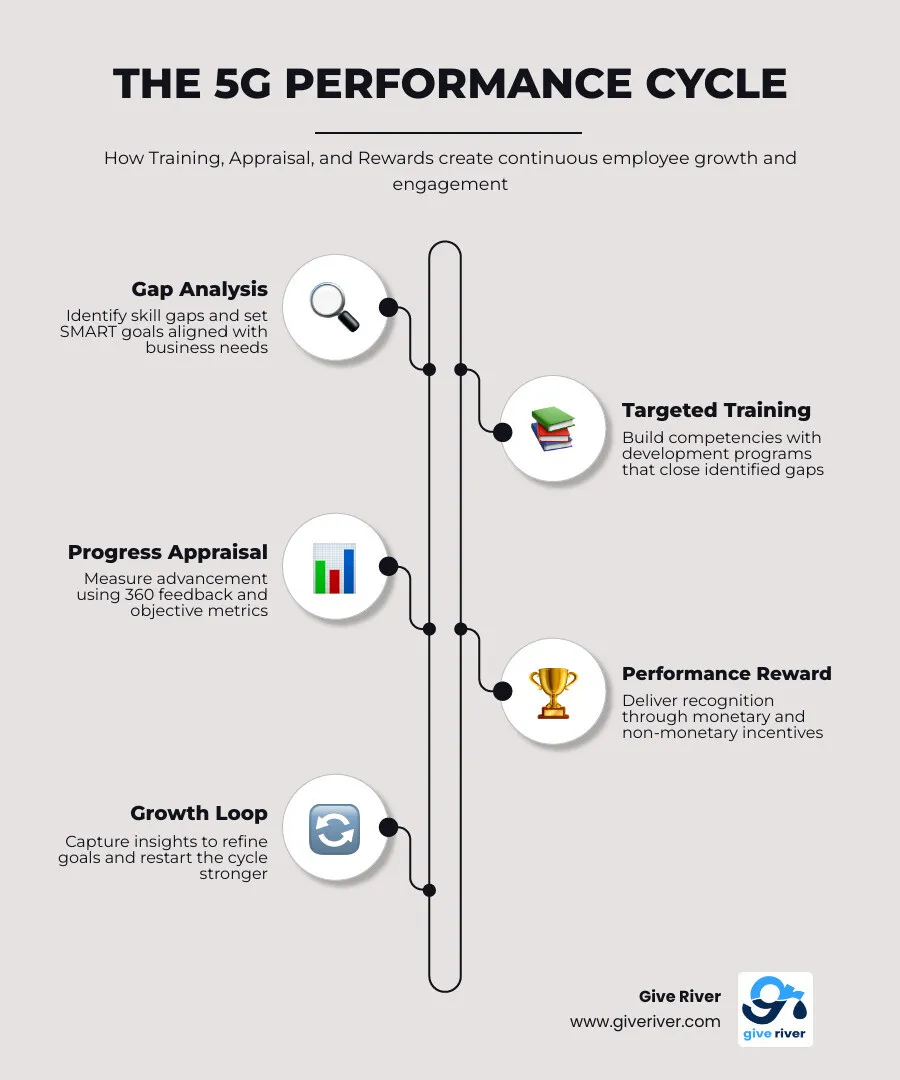
Know your training performance appraisal and reward system terms:
The Synergy of a Training Performance Appraisal and Reward System
In modern HR, we often treat training, appraisals, and rewards like three different islands. But empirical research shows they are part of the same archipelago. A study of organizational behavior found that while performance appraisals have a 48.4% impact on job satisfaction, training and development follows closely with a 44.1% impact.
When you link these together, you create a "symbiotic feedback loop." Training prepares the employee to succeed; the appraisal measures that success; and the reward system reinforces the behavior. Without training, an appraisal is just a list of failures. Without rewards, training feels like extra work with no payoff.

This synergy is vital because scientific research on employee engagement consistently shows that clarity and growth are the two biggest drivers of productivity. When employees see a clear path from "learning a skill" to "getting a great review" to "receiving a reward," their commitment to the organization skyrockets.
Why a Training Performance Appraisal and Reward System Boosts Engagement
Integration is the antidote to the "check-the-box" mentality. Traditional annual reviews are often backwards-facing and infrequent, leaving employees feeling anxious rather than empowered. By moving toward a continuous training performance appraisal and reward system, you shift the focus from past mistakes to future potential.
Continuous feedback ensures that goals remain aligned with the company's evolving needs. This alignment is what we at Give River call "Employee Fulfillment." It’s the feeling that your work matters and that you are being guided toward your best self. When an appraisal identifies a gap, the immediate response shouldn't be a "poor" rating—it should be a training opportunity.
For a deeper dive into modern evaluation methods, check out our Performance Appraisal Guide 2026 and see how to bridge the gap between Performance Appraisal and Rewards.
Best Practices for a Training Performance Appraisal and Reward System in 2026
As we move through 2026, the "standard" review is dead. High-performing cultures are now utilizing more sophisticated frameworks to ensure fairness and growth. Here are the pillars of a modern system:
- SMART Goals & OKRs: Objectives must be Specific, Measurable, Achievable, Relevant, and Time-bound. This removes the "guessing game" from appraisals.
- 360-Degree Feedback: Don't rely solely on a single manager's perspective. Include peers, subordinates, and even customers to get a holistic view of performance.
- Competency-Based Evaluations: Instead of just looking at "output," look at the skills and attributes (like leadership or collaboration) that drive that output.
- Separation of Conversations: While linked, it’s often best to separate the "developmental" feedback session from the "salary adjustment" session. This lowers anxiety and allows the employee to actually listen to the coaching.
To start implementing these today, refer to our Employee Recognition Action Plan Complete Guide or explore the fundamentals of Reward Management in HRM.
Balancing Monetary and Non-Monetary Incentives
Money matters—compensation is one of the top reasons people leave their jobs—but it isn't the only thing that keeps them. A truly comprehensive Employee Total Rewards Program balances the "hard" rewards with "soft" recognition.
| Reward Type | Examples | Best Used For... |
|---|---|---|
| Monetary | Bonuses, merit increases, commissions, profit sharing | High-stakes performance, hitting sales quotas, long-term retention. |
| Non-Monetary | Public recognition, extra PTO, career advancement, wellness perks | Daily motivation, building culture, rewarding collaborative behaviors. |
The most effective systems use "on-the-spot" recognition for small wins and structured monetary rewards for major milestones. This creates a culture of constant appreciation rather than a "once-a-year" bonus hunt.
Overcoming Challenges and Sustaining Long-Term Success
Even the best-designed training performance appraisal and reward system will face hurdles. Common issues include manager bias, a focus on short-term results at the expense of long-term health, and a lack of transparency that leads to "water cooler" resentment.
Overcoming these requires a commitment to a high-performing culture. According to research from McKinsey, companies with high-performing cultures create up to three times higher returns for shareholders. The secret is transparency and accountability.

Minimizing Bias Through Manager Training and Calibration
Bias is the silent killer of reward systems. Whether it's "recency bias" (only remembering what happened last month) or "halo effect" (letting one good trait overshadow poor performance), it erodes trust.
To fight this, organizations should implement calibration sessions. These are meetings where managers from different departments review their ratings together with HR to ensure that an "Outstanding" in Marketing means the same thing as an "Outstanding" in Engineering. Training managers on how to give objective, evidence-based feedback is the most important investment you can make in your Compensation Reward System Complete Guide.
Leveraging Technology for Peer-to-Peer Recognition
While manager-led recognition is essential, it can sometimes feel top-down or disconnected from the daily grind. This is where technology and peer-to-peer recognition come in. Platforms like Bonusly or Kudos allow employees to recognize each other in real-time for the small, helpful actions that managers might miss.
However, while platforms like Bonusly and Kudos excel at social recognition, Give River differentiates itself by creating a direct bridge between these social wins and your formal development goals. At Give River, we take this a step further with our Employee Points System Complete Guide. By gamifying recognition and tying it specifically to the 5G Method, you make growth fun and habitual. When an employee earns points for helping a teammate or completing a training module, they see immediate progress that feeds directly into their next appraisal. This real-time data also gives managers a much clearer picture during appraisal season—no more "forgetting" what happened in Q1!
Fostering a Culture of Growth and Fulfillment
Your training performance appraisal and reward system should serve a higher purpose: the fulfillment of your people. This is the heart of the Give River 5G Method. We believe that when you combine Guidance (clear appraisals), Growth (training), and Gratitude (rewards), you naturally foster Generosity and a Gamified sense of achievement.
By integrating wellness content and community impact into your rewards, you show employees that you care about them as whole people, not just "productivity units." This holistic approach is how you build a team that doesn't just work for a paycheck, but works for a purpose.
Ready to transform your workplace? Learn How to Build the Best Total Rewards Package for Your Employees or explore our comprehensive employee reward solutions.
Summary of Key Takeaways:
- Integrate to Elevate: Linking training, appraisals, and rewards can explain nearly 100% of the variance in job satisfaction.
- Continuous is Better: Shift from annual "judgments" to ongoing "coaching" conversations supported by real-time data.
- Balance Your Rewards: Use monetary incentives for results and non-monetary recognition for behaviors and culture-building.
- Train Your Appraisers: Calibration and bias training are essential to maintain the integrity of your system.
- Leverage Technology: Use gamification and peer-to-peer tools to make recognition a daily habit rather than a yearly event.
More from this category.
Best Employee Recognition Software for Nonprofits (2026)
What nonprofits need from recognition software, what six platforms charge mission-driven teams, and how to get a grant-funded Season of Give River for free.

Employee Recognition Software Pricing in 2026: What 6 Platforms Charge
What Give River, Bonusly, Motivosity, Nectar, Awardco, and Workhuman charge in 2026, from their own sites: pricing models, minimums, fees, and contract terms.

How to Improve Employee Recognition Across Multiple Locations
Six practical ways to make recognition reach every site and shift, what to look for in a platform, and how a 25-location nonprofit did it.
See the platform in action.
Free for up to 25 members, or try Core or Growth free for 30 days. A card is required; Free is never charged, and a trial bills when it ends unless you cancel.