Defining Ethical Responsibility in the Modern Workplace
Ethical responsibility is the obligation — for individuals, leaders, and organizations — to act in ways that align with moral principles, fairness, and respect for others, going beyond what the law simply requires.

Ethical responsibility is the obligation — for individuals, leaders, and organizations — to act in ways that align with moral principles, fairness, and respect for others, going beyond what the law simply requires.
Quick answer: What is ethical responsibility?
| Dimension | What it means |
|---|---|
| Definition | The duty to act morally and justly, considering the impact on people, communities, and the planet |
| Beyond the law | Legal compliance is the floor, not the ceiling — ethical responsibility asks what's right, not just what's permitted |
| In practice | Honesty, transparency, fairness, accountability, and concern for stakeholder well-being |
| For leaders | Recognizing obligations to customers, employees, investors, and society — especially in gray-area decisions |
| For organizations | Building cultures where ethical behavior is expected, modeled, and rewarded at every level |
Most leaders understand they need to follow the rules. Fewer realize that the real competitive edge lies in going further — in building organizations where people trust you, not just comply with you.
Think about a restaurant that discovers one of its ingredients may have spoiled. Legally, the owner might not be required to act until someone gets sick. Ethically, the answer is obvious — pull the product, protect the customer, absorb the cost. That gap between legal and right is exactly where ethical responsibility lives.
And in today's workplace, that gap matters more than ever. Employees, customers, and investors increasingly expect organizations to stand for something beyond profit. Boards that ignore this reality face reputational damage, talent loss, and eroding trust — all of which carry very real financial consequences.
I'm Meghan Calhoun, co-founder of Give River and a workplace culture strategist with over two decades of experience building high-performing teams across high-pressure industries — where I learned that ethical responsibility isn't a soft ideal, it's a foundational driver of sustainable performance. In this guide, I'll walk you through the principles, frameworks, and practical steps that can make ethical responsibility your organization's quiet superpower.
Ethical responsibility word list:
- advantages of corporate social responsibility
- csr definition
- what is corporate social responsibility
To understand ethical responsibility, we have to look back at its roots. The word "ethics" comes from the Greek ethos, meaning moral character. In a business context, this translates to the consistent practice of doing what is right, even when it’s inconvenient or expensive. As we move through April 2026, the bar for what constitutes "right" has moved significantly higher.
What is Ethical Responsibility vs. Legal Duty?
One of the most common mistakes leaders make is conflating legal compliance with ethical responsibility. While they overlap, they are distinct forces.
- Legal Duty: This is your "must-do" list. It is the minimum standard set by the government to prevent harm or fraud. If you break these rules, you face fines or jail time.
- Economic Obligation: This is the "should-do" for survival. Businesses have a duty to remain profitable and provide value to shareholders.
- Ethical Responsibility: This is the "ought-to-do." It involves discretionary actions based on conscience, social norms, and the social responsibility meaning and definition that your organization chooses to uphold.
| Responsibility Type | Driver | Consequence of Failure |
|---|---|---|
| Legal | Legislation/Regulation | Lawsuits, fines, imprisonment |
| Economic | Market forces/Investors | Bankruptcy, loss of capital |
| Ethical | Moral principles/Values | Loss of trust, brand damage, high turnover |
In the modern era, "Conscious Capitalism" argues that businesses are morally accountable even when their actions are perfectly legal. For example, using a loophole to avoid environmental cleanup might be legal, but it fails the test of ethical responsibility.
The Core Elements of Ethical Responsibility
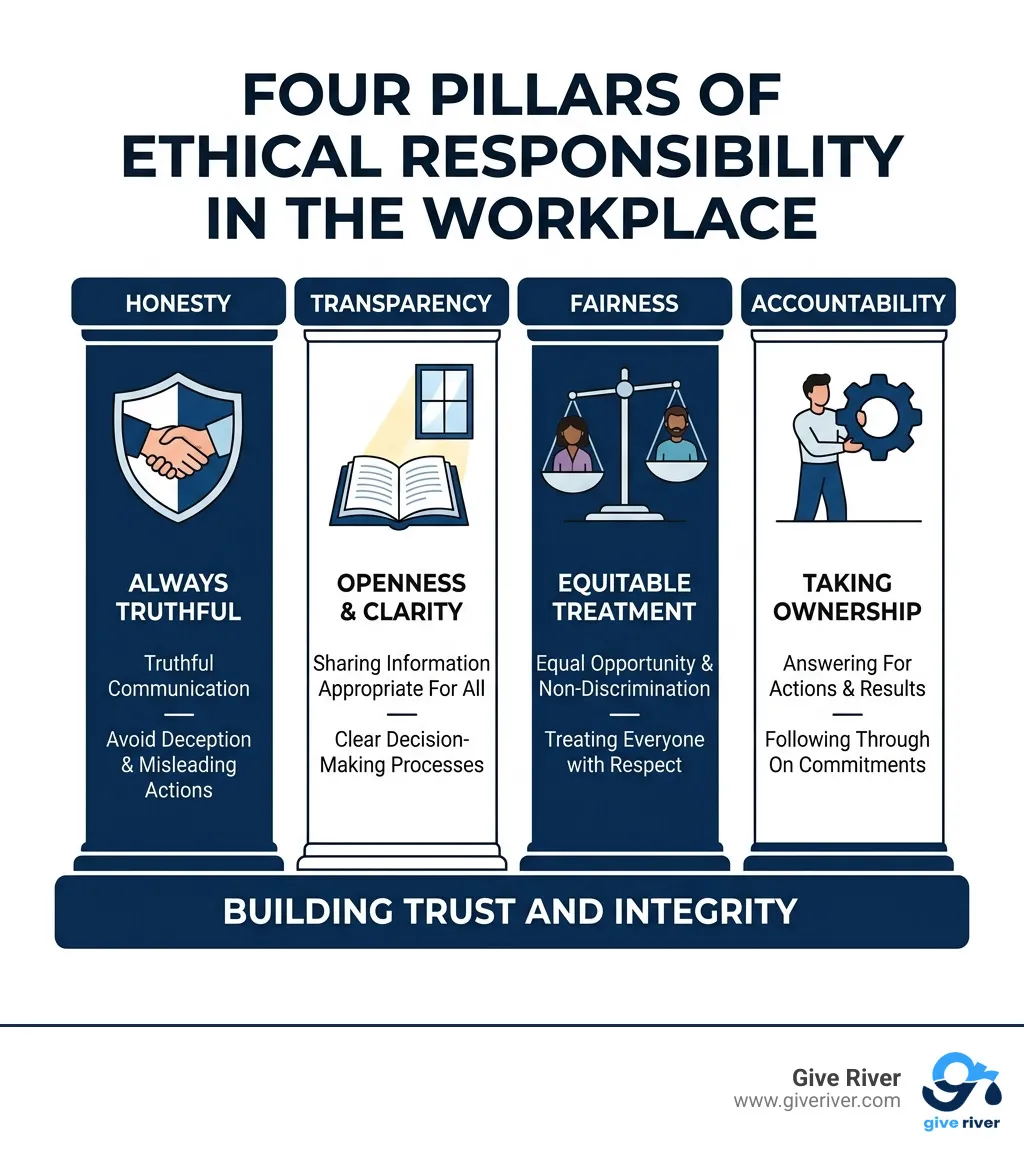
What does ethical responsibility actually look like on a Tuesday morning in the office? It boils down to four non-negotiable elements:
- Honesty: Being truthful in all communications, from marketing claims to internal feedback.
- Transparency: Openness about decisions, finances, and even failures. This is the antidote to "information asymmetry," where leaders know more than stakeholders.
- Fairness: Ensuring equitable treatment in hiring, promotions, and compensation. This includes sustainable business practices that ensure long-term viability for the community.
- Accountability: Taking ownership of outcomes, whether they are positive or negative.
Philosophically, Scientific research on moral responsibility suggests that for someone to be held responsible, they must possess the capacity for reflection and intentionality. In 2026, we apply this same standard to "corporate agents"—the organizations themselves.
Implementing Ethical Responsibility for Organizational Success
Knowing what is right is one thing; doing it in the heat of a quarterly crunch is another. This is where frameworks become essential.
The Reflective Leadership Model for Decision-Making
At Give River, we advocate for the Reflective Leadership Model. This framework helps leaders navigate those "gray areas" where there isn't a clear-cut right answer. It consists of four stages:
- Awareness: Recognizing that a situation has an ethical dimension. This requires looking past the immediate "economic" gain to see the human impact.
- Judgment: Analyzing the situation while identifying your own biases. Are you favoring a certain outcome because it’s easier?
- Action: Implementing the decision with full accountability. This involves communicating the why behind the choice.
- Reflection: This is the most overlooked step. After the dust settles, leaders must look back to learn. Reflection is a lifelong process that refines your "moral compass" for the next challenge.
This model is particularly useful when dealing with power dynamics. Leaders often hold more power and information than their employees or customers. Ethical responsibility demands that we do not exploit these asymmetries but rather use our position to protect those with less leverage.
Fulfilling Duties to Stakeholders and Society
Your ethical responsibility extends in multiple directions simultaneously.
- To Customers: You have a duty to ensure well-being (e.g., product safety) and respect rights (e.g., data privacy). Because you know more about your product than the customer does (information asymmetry), you are ethically bound to be their advocate.
- To Employees: Beyond paying a fair wage, this involves procedural fairness—making sure the "rules of the game" are clear and applied equally to everyone.
- To Investors: This is often referred to as fiduciary duty. It includes obedience to the mission, loyalty to the organization’s interests, and the "duty of care" to make informed, prudent decisions.
- To Society: This is where what is corporate social responsibility comes into play. Organizations are increasingly judged on their csr and esg initiatives, which measure their impact on the planet and social justice.

Navigating Business Ethics and Social Responsibility
While often used interchangeably, there is a subtle difference between business ethics and social responsibility.
- Business Ethics is the "micro" view: it’s about the internal conscience of the firm and the rightness of specific acts (e.g., "Should we accept this donation from a controversial source?").
- Social Responsibility is the "macro" view: it’s about the organization’s role in the larger ecosystem.
The intersection of these two is the Triple Bottom Line: Profit, People, and Planet. Scientific research on the impact of CSR on shareholder value has shown that there is often a positive correlation between social responsibility and long-term financial performance. Far from being a distraction, being a "good corporate citizen" actually reduces risk and enhances reputation, making the company more resilient during economic downturns.
Cultivating a Speak-Up Culture with Give River
Even the best-intentioned leaders can’t be everywhere at once. To truly uphold ethical responsibility, you need to build a "speak-up culture" where every team member feels safe calling out unethical behavior.
This is where Give River’s 5G Method (Guided, Gamified, Gratitude, Growth, and Generosity) creates a competitive advantage. While platforms like Bonusly or Kudos focus primarily on peer-to-peer recognition and transactional rewards, Give River differentiates itself by integrating ethical growth and community impact directly into the daily workflow. Unlike these traditional platforms that often stop at social praise, Give River’s 5G Method ensures that recognition is tied to broader social responsibility goals, helping employees see the tangible impact of their ethical choices.
When you use our recognition platform, you aren’t just saying "good job" on a project. You are reinforcing the values of honesty and generosity. By gamifying "Generosity" and "Growth," we help organizations move beyond simple engagement to genuine fulfillment.
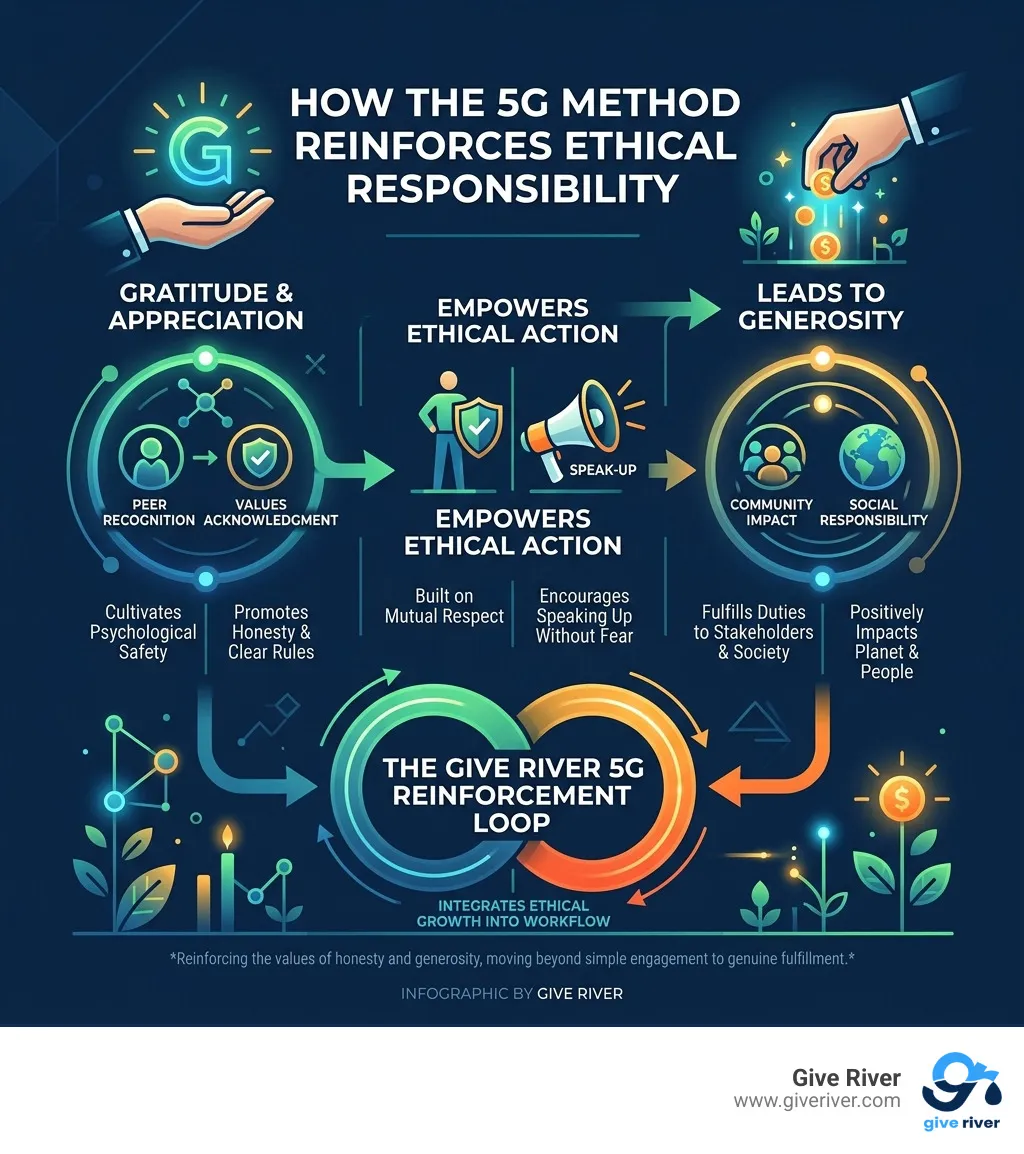
When employees feel fulfilled and psychologically safe, they are more likely to act as the "ethical sensors" for the organization. They know that if they see something wrong, they can speak up without fear of retaliation, because the culture is built on a foundation of mutual respect and shared moral purpose.
Practical Steps to Uphold Ethical Responsibility
If you are ready to turn ethical responsibility into your organization's secret superpower, here is an actionable roadmap to get started:
1. Create (and Actually Use) a Code of Ethics
A code of ethics shouldn't just sit in a dusty PDF on your intranet. It should be a living document that specifies:
- Expected behaviors (e.g., "We disclose all potential conflicts of interest immediately").
- Prohibited actions (e.g., "We do not accept gifts from vendors exceeding $50").
- Clear consequences for violations.
2. Implement Regular Ethics Training
Ethics isn't a "one-and-done" orientation topic. In April 2026, the most successful companies run regular workshops that use real-world scenarios. Instead of lecturing on rules, facilitate "gray-area" discussions. For example: "A long-term supplier has been found using unsafe labor practices in a sub-factory. We are in the middle of a critical production run. What do we do?"
3. Establish Anonymous Reporting Channels
Trust is the currency of ethical responsibility, but sometimes fear of power dynamics wins out. Provide anonymous hotlines or encrypted online reporting systems where employees can flag concerns. Ensure these reports go directly to a board committee or a third-party auditor to maintain integrity.
4. Reward Ethical Behavior
Most companies only punish the "bad guys." To build a thriving culture, you must also reward the "good guys." Use your ethical business models to recognize employees who prioritize honesty over short-term gains.
At Give River, we see this every day: when a leader publicly thanks an employee for "doing the right thing" in a difficult situation, it sends a more powerful message than any handbook ever could.
Conclusion: The Long-Term ROI of Doing Right
In the end, ethical responsibility is about legacy. It’s about the difference between a company that exists to extract value and a company that exists to create it.
By embracing the principles of honesty, transparency, and fairness, you do more than just avoid a lawsuit. You build a brand that customers want to support, a workplace where the best talent wants to stay, and a business that is built to last.
The "Secret Superpower" isn't that you're perfect—it's that you are committed to the process of reflection, learning, and improvement. Whether you are a board member, a manager, or an individual contributor, your choices shape the moral fabric of your organization.
Ready to transform your workplace culture? At Give River, we help you build high-performing teams through the power of gratitude and generosity. Explore our recognition platform and see how the 5G Method can turn your ethical values into measurable results.
More from this category.

Why Most Work Meetings Start on the Wrong Foot (And How to Fix It)
The best 2 truths and a lie ideas for work can transform an awkward, silent meeting opener into a moment your team actually looks forward to. Whether you're onboarding new hires, kicking off a remote all-hands, or just trying to shake off…

The Trust Deficit in Remote Work
Building trust in a virtual team is a critical challenge for modern organizations. While remote work offers flexibility, it can erode team cohesion if not managed intentionally.

Why Connection Building Activities Are the Secret to High-Performing Teams
Connection building activities are structured exercises that help teams develop trust, improve communication, and foster genuine relationships at work — and they're one of the most overlooked drivers of team performance.
See the platform in action.
Free for up to 25 members, or try Core or Growth free for 30 days. A card is required; Free is never charged, and a trial bills when it ends unless you cancel.