The Growing Synergy Between Governments and Corporate Responsibility
Government CSR initiatives are reshaping corporate social responsibility worldwide. Instead of leaving corporate behavior to chance, governments are creating frameworks and partnerships to guide businesses toward positive social and…

Government CSR initiatives are reshaping corporate social responsibility worldwide. Instead of leaving corporate behavior to chance, governments are creating frameworks and partnerships to guide businesses toward positive social and environmental impact. From Canada's extractive sector strategy to India's mandatory CSR laws, a new landscape is emerging where public policy and private purpose intersect.
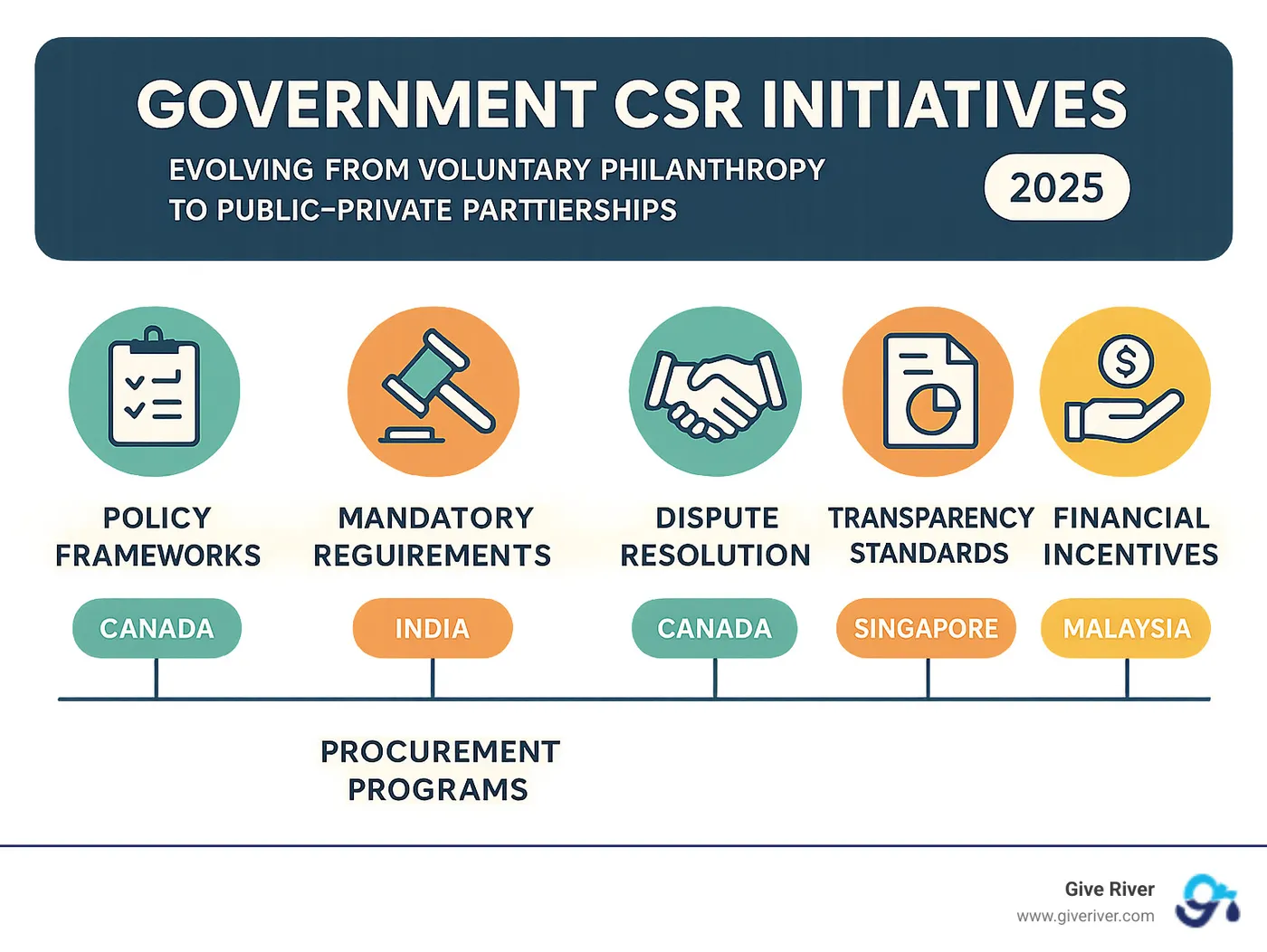
Key Government CSR Initiative Types:
- Policy Frameworks - Strategic guidelines like Canada's "Doing Business the Canadian Way"
- Mandatory Requirements - Legal obligations such as India's Companies Act 2013
- Procurement Programs - Social impact purchasing like Malaysia's PPISK initiative
- Dispute Resolution - Mediation services through offices like Canada's CSR Counsellor
- Transparency Standards - Reporting requirements and international guideline adoption
- Financial Incentives - Preferential treatment for compliant companies
This shift reflects a fundamental change from CSR as voluntary philanthropy to CSR as a strategic partnership between public and private sectors. The numbers tell the story: Canadian companies have invested over $60 billion in developing countries, and their mining companies account for nearly 31% of global exploration expenditures. With this influence comes responsibility—and governments are ensuring it translates into positive impact.
I'm Meghan Calhoun, and through my experience building workplace culture initiatives and co-founding Give River, I've seen how government CSR initiatives create frameworks that help companies align profit with purpose. Understanding these evolving partnerships is crucial for any leader seeking to build sustainable business practices that meet both regulatory expectations and employee values.
Related content about government csr initiatives:
A Global Look at Government CSR Initiatives and Frameworks
The landscape of Corporate Social Responsibility has evolved from voluntary charity into sophisticated government CSR initiatives that shape global business operations. This reflects a growing understanding that companies can drive positive change—and governments are ensuring that power is used responsibly.
Canada's Blueprint: A Deep Dive into the Extractive Sector CSR Strategy
Canadian companies have a massive global footprint, especially in mining, accounting for nearly 31% of global exploration spending. With this influence comes responsibility, which Canada addresses through its "Canadian Advantage" CSR strategy.

Canada's 2014 framework, "Doing Business the Canadian Way," moves beyond simple encouragement. It's about enhancing competitiveness, managing risks, and securing long-term operational licenses. The strategy promotes international guidelines, invests in host country capacity-building, and provides dispute resolution through the Office of the Extractive Sector CSR Counsellor. Crucially, it introduces accountability: companies that don't adhere to best practices risk losing Government of Canada support, including diplomatic and trade commissioner assistance. This shifts CSR from a recommendation to an expectation.
The Role of International Standards and Transparency in Government-Backed CSR
Effective government CSR initiatives rely on universal standards to create consistency and trust across borders. These frameworks act as a common language for responsible business.
- The OECD Guidelines for Multinational Enterprises offer comprehensive recommendations on human rights, labor, and environmental protection.
- The UN Guiding Principles on Business and Human Rights establish the "Protect, Respect and Remedy" framework.
- The IFC Performance Standards are the gold standard for managing social and environmental risks in project financing.
- The Global Reporting Initiative (GRI) provides standardized sustainability reporting guidelines.
Transparency is the backbone of these initiatives. Canada's Extractive Sector Transparency Measures Act (ESTMA) legally requires companies to report payments to governments, meeting market demand for accountability from socially responsible investors.
For companies seeking to understand the full scope of these responsibilities, our comprehensive guide on What is Corporate Social Responsibility? provides valuable context for navigating this evolving landscape.
Fostering Accountability: Dispute Resolution and Corporate Incentives
Smart government CSR initiatives include robust mechanisms for resolving disputes before they escalate.

Canada's Office of the Extractive Sector CSR Counsellor offers dialogue-based mediation, providing a constructive, non-adversarial path to problem-solving. The business case for using such tools and embracing CSR is clear. Companies with strong CSR performance enjoy reputational advantages, superior risk management, and improved access to capital, with ESG leaders commanding an 11% valuation premium. They also see boosts in employee morale and retention. Conversely, non-compliance with Canada's strategy can lead to tangible repercussions, like the withdrawal of diplomatic support, reinforcing that CSR is integral to national interests.
For deeper insights into these benefits, explore our analysis of the Advantages of Corporate Social Responsibility.
Pioneering Mandates and Procurement: Global Examples of Government CSR Initiatives
While Canada favors a guidelines-based approach, other nations have pioneered different models for government CSR initiatives.
- India's Companies Act 2013 is a bold experiment in mandatory CSR. Qualifying companies must spend 2% of their average net profits on designated activities like education, health, and environmental sustainability.
- Singapore's GreenGov.SG initiative shows governments leading by example, committing the public sector to net-zero emissions and incorporating sustainability into all government procurement by 2028.
- Malaysia's Government Social Impact Procurement Programme (PPISK) uses government purchasing power to support social enterprises, giving them preferred vendor status.
These diverse strategies show a global trend: corporate power must be channeled toward societal benefit, whether through voluntary frameworks, legal mandates, or market-based incentives.
| Aspect | Canada (Extractive Sector) | India (Companies Act 2013) |
|---|---|---|
| Approach | Voluntary with accountability measures | Legally mandated spending requirements |
| Focus | International operations, risk management, "Canadian Advantage" | Domestic development, inclusive growth, legal compliance |
| Mechanism | Guidelines, dispute resolution, capacity building, support withdrawal | 2% profit spending requirement, specified activities, penalties |
| Accountability | Reputational consequences, government support withdrawal | Legal penalties, regulatory enforcement |
| Target Areas | Environmental/social risk, human rights, transparency | Community development, education, health, poverty reduction |
Understanding these diverse approaches helps companies steer a complex global landscape where government CSR initiatives shape operational requirements and stakeholder expectations.
From Policy to Practice: Aligning Your Business with Public Sector CSR
Knowing about government CSR initiatives is the first step. The real opportunity lies in weaving that knowledge into practical strategies that create value for your business, people, and communities. Companies that align their CSR efforts with public sector frameworks don't just achieve compliance—they open up potential for growth, innovation, and engagement.
A Practical Guide to Implementing a CSR Strategy
Building an impactful CSR strategy requires a systematic approach. A "Plan-Do-Check-Improve" cycle keeps your efforts relevant and effective.

- Plan: Start with a materiality assessment to identify the social and environmental issues most relevant to your business and stakeholders. Align your CSR vision with core business values and government priorities.
- Engage: Foster an ongoing dialogue with stakeholders—employees, customers, communities, and government bodies. This builds trust and uncovers opportunities. True Community Involvement Programs are about co-creation, not just writing checks.
- Implement: Integrate CSR into daily operations, decision-making, and supply chains. Assign clear responsibilities and allocate resources. Employee involvement is critical; your team understands your operations and can drive innovation. When employees connect to a purpose, engagement soars.
- Monitor & Report: Use CSR reporting to transparently communicate your progress and tell your story. Stakeholders increasingly demand this transparency.
- Improve: Regularly evaluate what's working and what isn't. CSR is a journey of continuous learning and adaptation.
Implementing a CSR strategy often involves employee engagement tools. While platforms like Bonusly or Kudos excel at peer-to-peer recognition and rewards, they are primarily focused on internal morale. Give River differentiates itself by connecting that internal engagement to external community impact. Our platform is specifically designed to manage, track, and amplify corporate giving and volunteering programs, turning employee recognition into measurable social good. This focus on dedicated CSR program management goes beyond general recognition to help companies build a comprehensive culture of generosity.
The Business Case: Open uping Value Through Strategic Government CSR Initiatives
Embracing government CSR initiatives and robust CSR practices isn't about avoiding trouble—it's about open uping value and building a resilient business.
- Risk Management & Efficiency: Proactively addressing social and environmental issues helps avoid costly disputes and operational disruptions. Practices like waste reduction and energy conservation often lead directly to cost savings.
- Reputation & Trust: Authentic CSR efforts boost your brand. In today's conscious marketplace, this trust translates into a significant competitive advantage, with ESG leaders earning an 11% valuation premium.
- Innovation & Competitiveness: Sustainability challenges drive innovation, leading to new products, services, and business models. CSR-focused companies tend to be more agile and adaptable.
- Access to Capital: With socially responsible investing (SRI) growing, companies with strong CSR practices find it easier to attract capital from this expanding pool of ethical investors.
- Talent Attraction & Retention: Today's workforce seeks purpose. Companies with strong CSR and highly engaged employees see better financial performance and higher retention rates.
- Social License to Operate: Positive relationships with local communities are essential for long-term success. Aligning with public sector goals strengthens this social license, ensuring continued acceptance and support for your operations.
Aligning with public sector goals not only strengthens your social license to operate but also boosts morale and attracts top talent. Give River's platform helps companies translate these high-level strategies into tangible actions, fostering a culture of generosity and purpose. We provide tools for recognizing employee contributions to community efforts, gamifying positive impact, and creating clear pathways for charitable giving. This integrated approach ensures that your CSR strategy becomes a living, breathing part of your organization's identity.
To explore how your company can maximize its positive impact, find how we can help you Learn how to maximize your Charitable Impact. Our solutions empower businesses to create meaningful change, one impactful action at a time.
More from this category.

The Importance of Community Involvement
Community involvement programs are the heartbeat of social wellbeing, changing neighborhoods into collaborative and vibrant spaces. At their core, these programs enable both individuals and businesses to meaningfully participate in…

Recognition Software With Charitable Giving (2026): 6 Platforms Compared
Most recognition platforms let employees donate their rewards. Six compared on donations, company match, causes, and volunteering, from each vendor's own site.

Why Community Involvement Grants Matter for Your Organization's Impact
Community involvement grants provide essential funding to help organizations—from nonprofits and schools to businesses—create meaningful change. These grants can feel overwhelming to steer, but they offer a powerful way to address critical…
See the platform in action.
Free for up to 25 members, or try Core or Growth free for 30 days. A card is required; Free is never charged, and a trial bills when it ends unless you cancel.