Why the "Awkward Silence" Is Costing Your Team More Than You Think
Virtual ice breaking games are structured, interactive activities designed to energize participants, spark conversation, and build genuine connection at the start of a remote or hybrid meeting. Here's a quick look at the most effective…

Virtual ice breaking games are structured, interactive activities designed to energize participants, spark conversation, and build genuine connection at the start of a remote or hybrid meeting. Here's a quick look at the most effective options:
| Game | Best For | Time Needed |
|---|---|---|
| Two Truths and a Lie | Small to mid-size teams | 5-10 min |
| Home Scavenger Hunt | High-energy groups | 5-10 min |
| One-Word Check-In | Any size, any meeting | Under 2 min |
| Guess Who (Fun Facts) | Onboarding, new teams | 10-15 min |
| Would You Rather | Quick warm-ups | 3-5 min |
| Virtual Trivia | Large groups | 15-20 min |
| Word Cloud Poll | 20+ participants | Under 3 min |
We've all been there. The meeting starts, the host says "let's go around and introduce ourselves," and the next five minutes feel like a slow march through a corporate formality. Nobody's energized. Nobody's connecting. And the actual work that follows suffers for it.
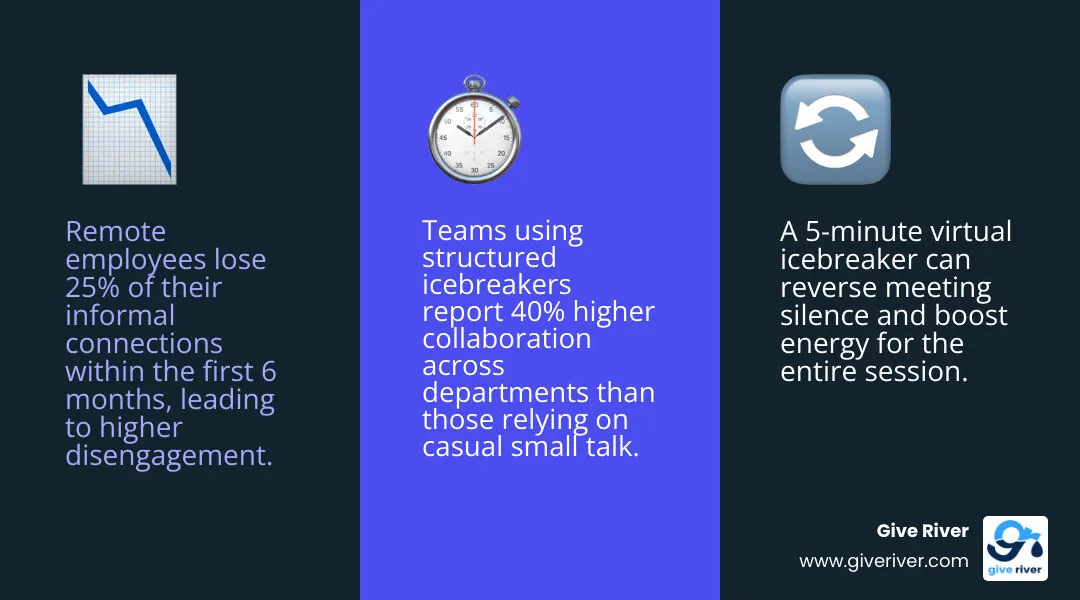
The problem runs deeper than awkward small talk. Research from Gallup shows that remote work significantly erodes the informal connections that hold teams together — employees tend to retreat into their immediate circles, collaborate less, and gradually disengage from the broader team culture. Low morale doesn't just feel bad; it drives absenteeism, productivity loss, and turnover.
The good news? The right virtual icebreaker — one that feels genuinely fun rather than obligatory — can shift the entire energy of a meeting in under five minutes. The challenge is finding activities your team will actually enjoy, not just tolerate.
I'm Meghan Calhoun, co-founder of Give River and a workplace wellness advocate with over two decades of experience building high-performing teams across industries — experience that taught me how virtual ice breaking games can be the difference between a disconnected team and a thriving one. In the sections ahead, I'll walk you through the games and strategies that actually work, organized by format, group size, and the culture you're trying to build.
Key virtual ice breaking games vocabulary:
Why Virtual Ice Breaking Games are Essential for Modern Teams

In the current landscape of May 2026, remote and hybrid work is no longer a "trend"—it is the standard. However, this flexibility comes with a hidden cost: the erosion of social capital. Statistics show that remote companies often struggle to establish healthy communication, with workers spending significantly less time collaborating with their colleagues than they did in traditional offices.
When we integrate virtual ice breaking games into our routines, we aren't just "playing." We are actively combatting the psychological and physical stress that remote work can sometimes induce. While remote work increases productivity and saves commuting time, it can lead to a sense of detachment.
By using Virtual Ice Breakers, we bridge that gap. These activities serve as a bridge, moving beyond transactional "work talk" and into the realm of human connection. This is vital because low team morale is a silent killer of competitiveness. When people feel seen and heard, they are more likely to contribute their best ideas.
The Science of Connection in a Digital Workspace

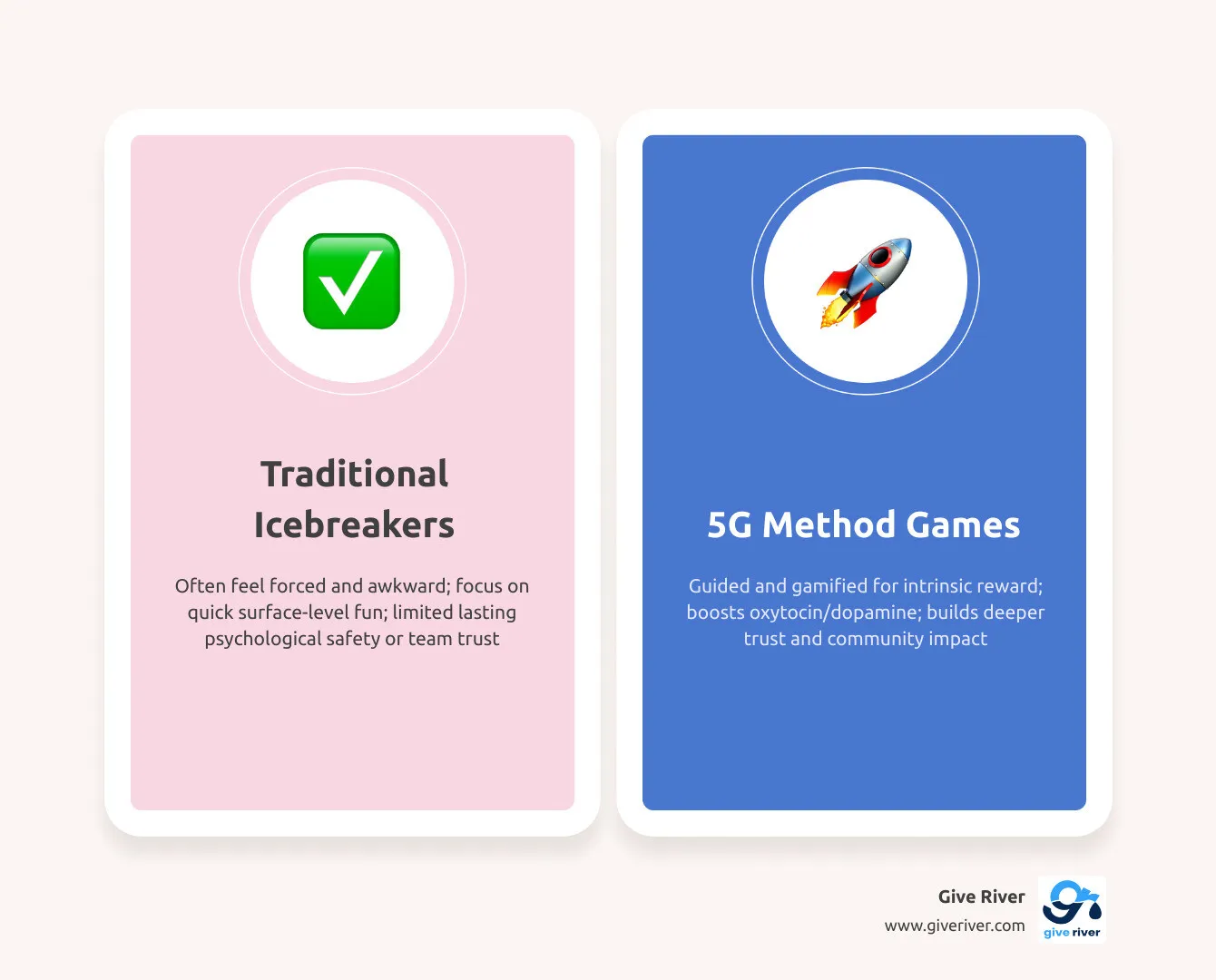
Why do some activities feel like a chore while others feel like a breath of fresh air? It comes down to the brain’s reward centers. When we engage in positive social interaction, our brains release oxytocin and dopamine, which lowers cortisol (the stress hormone) and increases our sense of psychological safety.
At Give River, we use our 5G Method—Guided, Gamified, Gratitude, Growth, and Generosity—to move beyond the surface. While platforms like Bonusly or Kudos focus primarily on peer-to-peer recognition and point-based rewards, Give River differentiates itself by focusing on the experience of connection. While those platforms are effective for rewarding performance, they don't always facilitate the initial social bonding that virtual ice breaking games provide. Our approach ensures that team building isn't just a transaction, but a shared journey that fosters deep-seated trust and community impact.
Quick and Easy Virtual Ice Breaking Games for Instant Engagement
Sometimes, you only have two minutes before a high-stakes presentation. You don't need a full-scale production to "break the ice." Here are a few high-impact, low-effort strategies:
- The Mood Barometer: Use a simple poll asking, "On a scale of 1-7, what is your energy level today?" This gives you an instant pulse check on the room.
- Word Clouds: Use tools like Slido or Mentimeter to ask, "Where are you joining us from?" or "What's one word to describe your week?" The visual result is a beautiful, collective representation of the team's current state.
- Emoji Check-ins: Ask everyone to drop the emoji that best describes their morning into the chat. It’s fast, visual, and often leads to a few laughs.
- The "One Word" Check-in: Ask each person to share one word that represents their focus for the meeting.
These Fun Ice Breaker Questions for Virtual Meetings require zero preparation but provide immediate engagement.
Interactive Virtual Ice Breaking Games to Boost Team Morale
If you have 10-15 minutes, you can dive into more interactive games that build lasting memories. These are the "meat and potatoes" of team bonding.
- Two Truths and a Lie (Professional Edition): Instead of random facts, ask for two true professional experiences and one lie. It’s a great way to learn about a colleague’s hidden skills or past career adventures.
- The "Home Office" Scavenger Hunt: Give the team 60 seconds to find something "yellow," "something that smells good," or "a souvenir from a trip." It gets people moving and provides a glimpse into their personal worlds.
- Virtual Guess Who: Collect a "weird fact" from everyone before the meeting. The host reads them out, and the team votes in the chat on who they think it is.
- Virtual Background Challenge: Ask everyone to set their background to their "dream vacation spot" or "the setting of their favorite movie" and have others guess the location.
For a deeper dive into these mechanics, check out our Virtual Team Games Ultimate Guide.
Adapting Activities for Hybrid and Large Group Settings
Facilitating for 50 people is vastly different than facilitating for five. In large groups, the biggest risk is "audience passivity." To combat this, we recommend:
- Strategic Breakout Rooms: If your group is larger than 10, split them into rooms of 3-4 people for icebreakers. This ensures everyone has a chance to speak without the session taking an hour.
- Meeting Equity: In hybrid settings, always let the remote participants speak first. This prevents the "in-room" group from dominating the conversation.
- Collaborative Whiteboards: Use tools like Miro or Zoom Whiteboard for visual brainstorming. Ask the team to draw their "current mood" or contribute to a "group story" where each person adds one sentence.
Using a Virtual Group Activities Team Building Guide can help you navigate these technical nuances and ensure no one feels like a spectator.
Common Pitfalls: How to Keep Icebreakers from Feeling Forced
We have all experienced "forced fun," and frankly, it’s the quickest way to kill morale. To keep your virtual ice breaking games from feeling cheesy, follow these rules of thumb:
- Make it Voluntary: Never force someone to share something deeply personal. Use a "pass" or "opt-out" policy to respect introverts and boundaries.
- Watch the Clock: An icebreaker should be a warm-up, not the main event. If it's scheduled for 5 minutes, keep it to 5 minutes.
- Model Vulnerability: As a leader, go first. If you're willing to share a silly mistake or a "guilty pleasure," your team will feel safe doing the same.
- The "Guided" Pillar: This is where Give River’s 5G Method shines. We provide the structure (the "Guidance") so the facilitator doesn't have to wing it, reducing the "cringe" factor for everyone involved.
For more tips on what to avoid, see our guide on Remote Working Icebreaker Games.
Conclusion: Building a Sustainable Culture of Connection
At the end of the day, virtual ice breaking games are more than just a way to kill time before a meeting. They are the building blocks of a resilient, high-performing workplace culture. By moving beyond simple engagement and toward true fulfillment, you create a space where employees feel valued as human beings, not just as "resources."
Through Give River’s 5G Method, we transform these small moments of connection into long-term cultural shifts. Whether it's through the power of gratitude, the thrill of gamification, or the shared purpose of community impact, we help you build a team that doesn't just work together—they grow together.
Ready to take your team culture to the next level? Explore how our team building solutions can help you turn every virtual meeting into an opportunity for growth and connection. Let's stop the awkward silence and start building something meaningful.
More from this category.

Why Most Work Meetings Start on the Wrong Foot (And How to Fix It)
The best 2 truths and a lie ideas for work can transform an awkward, silent meeting opener into a moment your team actually looks forward to. Whether you're onboarding new hires, kicking off a remote all-hands, or just trying to shake off…

The Trust Deficit in Remote Work
Building trust in a virtual team is a critical challenge for modern organizations. While remote work offers flexibility, it can erode team cohesion if not managed intentionally.

Why Connection Building Activities Are the Secret to High-Performing Teams
Connection building activities are structured exercises that help teams develop trust, improve communication, and foster genuine relationships at work — and they're one of the most overlooked drivers of team performance.
See the platform in action.
Free for up to 25 members, or try Core or Growth free for 30 days. A card is required; Free is never charged, and a trial bills when it ends unless you cancel.