Why Most Companies Are Losing the Talent War (And How the Right Resources Can Change That)
Employee development resources are the tools, programs, and systems organizations use to help their people grow their skills, advance their careers, and reach their full potential at work.

Employee development resources are the tools, programs, and systems organizations use to help their people grow their skills, advance their careers, and reach their full potential at work.
Here are the most effective types used by high-performing teams in 2026:
| Resource Type | Best For | Examples |
|---|---|---|
| Mentoring programs | Career growth & knowledge transfer | 1:1 mentoring, reverse mentoring, peer mentoring |
| Individual Development Plans (IDPs) | Goal alignment & accountability | Career roadmaps, SMART goal frameworks |
| AI-powered micro-learning | Scalable upskilling | Bite-sized courses, adaptive learning platforms |
| Job shadowing & stretch assignments | Experiential growth | Cross-functional projects, rotational roles |
| Leadership development programs | Building the next generation of leaders | Coaching, ERGs, succession planning |
| Mentoring & LMS software | Tracking & scaling programs | Chronus, Together, LinkedIn Learning |
Here is a number that should stop you in your tracks: 74% of employees say they cannot reach their full potential because their employer simply does not invest enough in their professional development. And when those employees leave — which 58% say they are likely to do without development opportunities — replacing them costs six to nine months of their salary.
That is not a minor inconvenience. For a mid-sized tech company losing five, ten, or twenty people per year, it is a serious financial wound — and a cultural one.
The good news? The gap between organizations that struggle with turnover and those that do not often comes down to one thing: intentional, structured investment in employee growth.
I'm Meghan Calhoun, co-founder of Give River and a workplace performance expert with over two decades of experience across high-pressure industries — and building employee development resources into the fabric of team culture is one of the most powerful levers I've seen leaders pull to transform both retention and results. In the guide below, I'll walk you through the exact tools and strategies that move the needle.
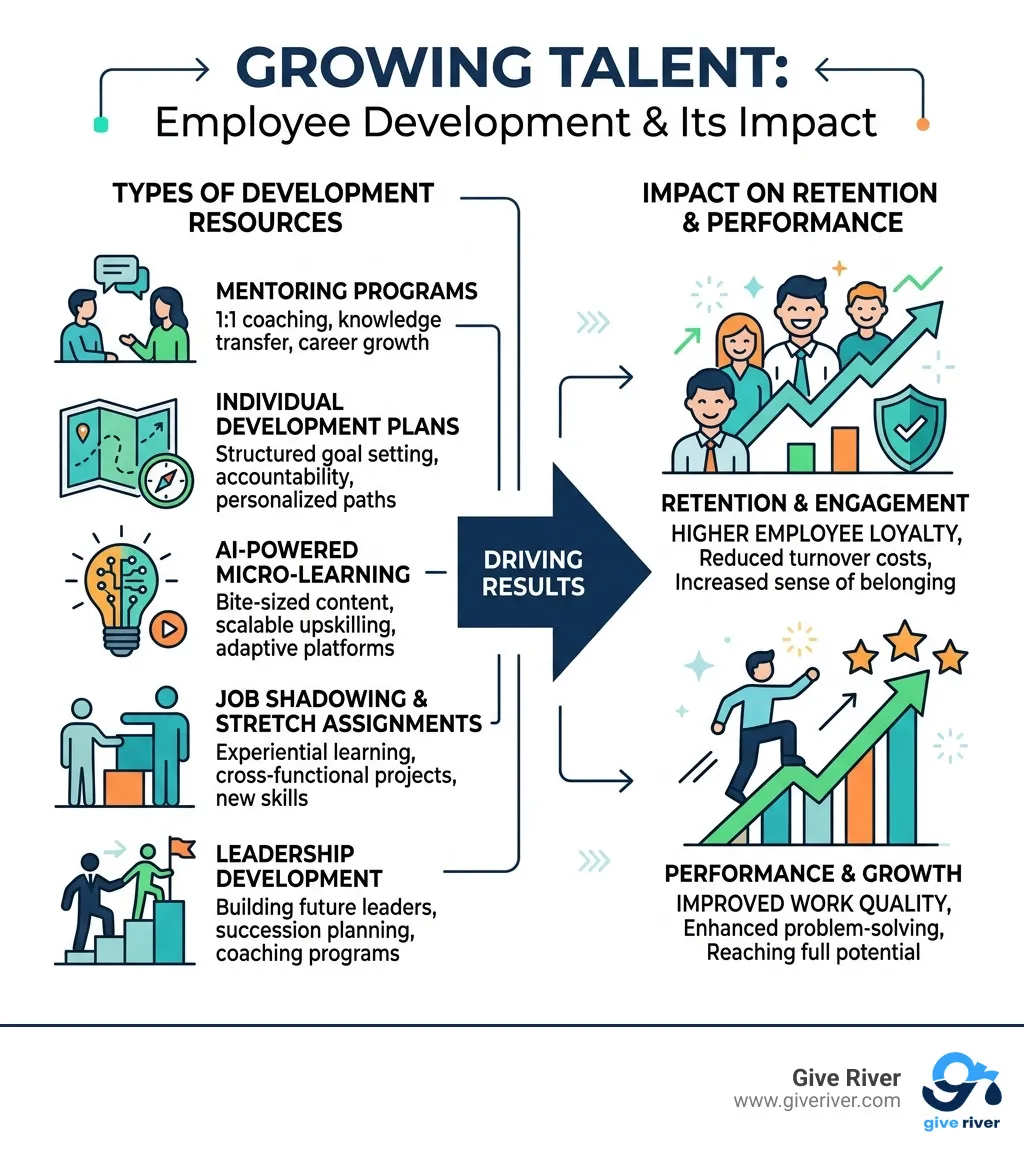
Simple guide to employee development resources:
Essential Employee Development Resources for Modern Teams
In the landscape of April 2026, the traditional "career ladder" has been replaced by the "career lattice." This shift means employees aren't just looking for the next rung up; they are looking for lateral moves, specialized upskilling, and broad experiential growth. To keep pace, our organizations must provide a variety of employee development resources that cater to different learning styles and career stages.
The financial argument for internal development is undeniable. While the average U.S. employer spends approximately $4,000 and 24 days to find and train a single new hire, the average annual spend on training for an existing employee is just $1,111. By shifting focus from external recruitment to internal upskilling, we aren't just saving money—we are building a more loyal, capable workforce.

| Activity | Estimated Cost | Time to Impact |
|---|---|---|
| New Hire Recruitment | $4,000+ | 3-6 Months |
| Annual Employee Training | $1,111 | Continuous |
| Mentoring Program | Software License | Immediate |
Mentoring Programs & Software: Scalable Employee Development Resources
One of the most effective employee development resources at our disposal is mentorship. Whether it’s pairing a new sales hire with an "onboarding buddy" or matching an aspiring controller with a seasoned finance executive, mentorship facilitates the transfer of "tribal knowledge" that manuals simply can't capture.
Modern Workplace Mentorship Software has revolutionized how we scale these connections. Gone are the days of HR managers manually matching pairs on spreadsheets. Tools like Together or Chronus allow for automated matching based on skills, goals, and even diversity initiatives. For example, Career Development Mentoring Programs can now include "reverse mentoring," where junior employees help senior leaders understand emerging market trends or digital tools, fostering a culture of mutual respect and continuous learning.
AI and Digital Tools as Employee Development Resources
As we move deeper into 2026, AI has transitioned from a buzzword to a fundamental workplace tool. The demand for AI literacy is skyrocketing, making AI Tools for Learning and Development essential. These tools don't just teach AI; they use AI to personalize the learning experience.
Adaptive learning platforms can identify an employee's skill gaps and deliver Micro Learning for Training Employees in bite-sized, manageable chunks. This approach respects the "flow of work," allowing team members to learn during short breaks rather than losing entire days to off-site seminars. Scientific research suggests that this type of spaced repetition and continuous engagement significantly improves retention and cognitive flexibility. For a deeper dive into the tech stack, check out our Learning and Development Tools Guide.
Implementing and Measuring Your Development Strategy
Creating a library of employee development resources is only half the battle. To see a real return on investment, we must integrate these tools into a cohesive strategy. This requires top-down executive sponsorship; if leadership doesn't value growth, the rest of the team won't either.
Setting SMART (Specific, Measurable, Achievable, Relevant, and Time-bound) goals is the foundation of Professional Development in Business. Without clear objectives, development efforts become aimless. By aligning individual growth with organizational needs, we create a win-win scenario where the company becomes more profitable as the employee becomes more skilled.

Creating Effective Individual Development Plans (IDPs)
The Employee Development Plan (IDP) is the roadmap for an employee's journey. While HR provides the framework, the employee should own the process. A successful IDP includes:
- Self-Assessment: Where am I now?
- Career Goals: Where do I want to be in 1-3 years?
- Development Objectives: What specific skills do I need?
- Action Steps: What resources (courses, mentoring, job shadowing) will I use?
- Timeline: When will I achieve these milestones?
For inspiration, you can look at a Career Development Program Sample Guide. Real-world examples show the power of this approach; for instance, the engineering firm CDM Smith saved an estimated $3.2 million by reducing turnover through their structured "Career Compass" program, which emphasized clear development pathways.
Real-World Success Stories: From Heineken to Wellabe
What do the Best Career Development Programs look like in practice? Let's look at some industry leaders.
- Heineken: By implementing "Inclusive Practices" programs, which included leadership development specifically for female talent, they achieved a milestone of 31% women in senior management roles. This demonstrates how targeted employee development resources can solve specific diversity and inclusion challenges.
- Wellabe: This insurance company saw a 23 percentage point lift in employee engagement after automating their mentorship program. By making growth opportunities accessible and easy to navigate, they turned development into a core part of their value proposition.
There are numerous Advantages of Career Development Programs, but the most significant is the creation of a talent pipeline that is ready to step into leadership roles as the company grows.
Measuring ROI and Program Success
We often hear that "what gets measured gets managed." To prove the value of your Learning and Development Solution, you must track key performance indicators (KPIs).
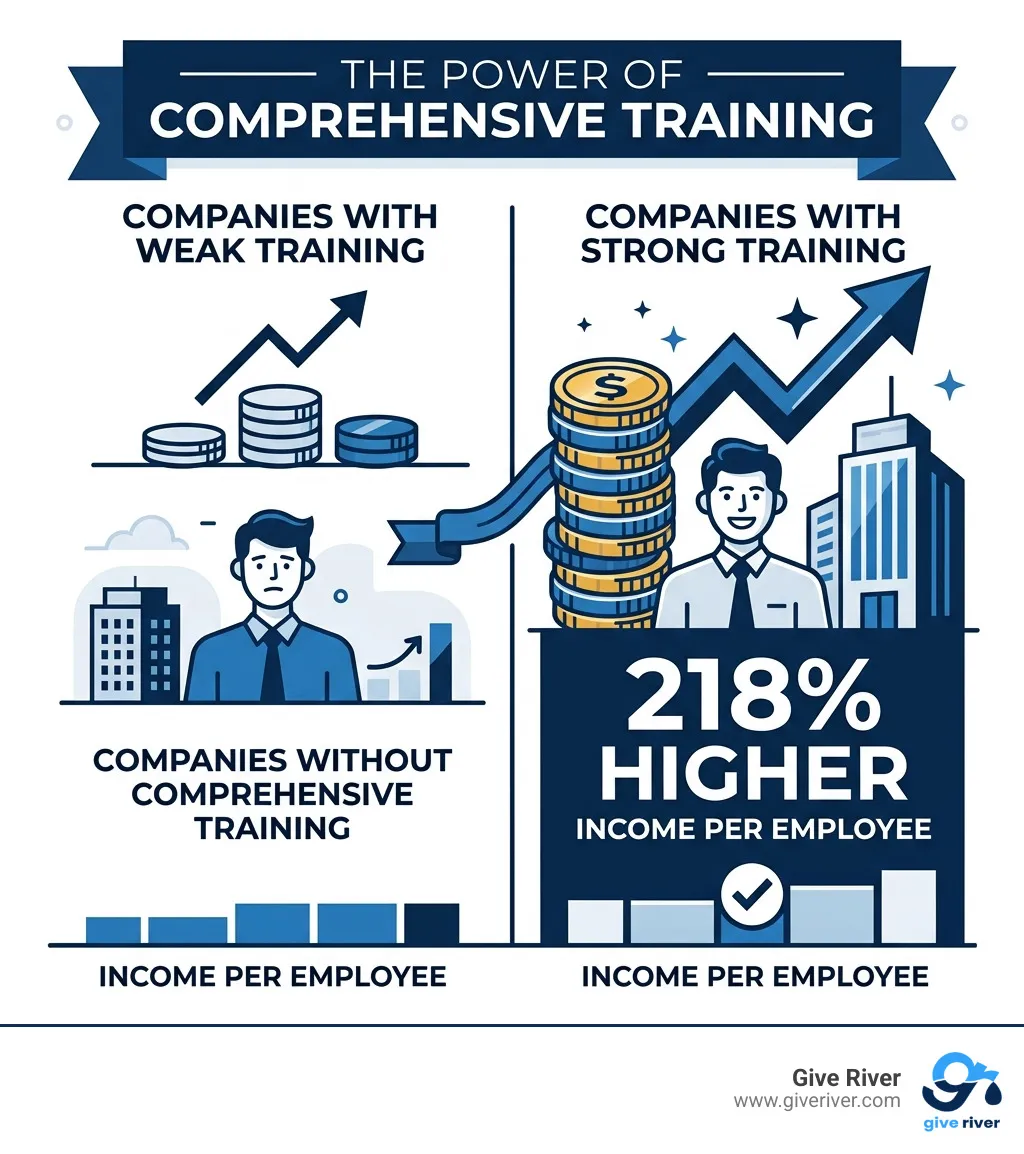
Companies that offer comprehensive training enjoy a 24% higher profit margin and a staggering 218% higher income per employee compared to those that don't. Beyond the balance sheet, we should track:
- Retention Rates: Are employees staying longer?
- Promotion Rates: Are we filling roles from within?
- Skill Acquisition: Are employees passing certifications or demonstrating new competencies?
- Employee Satisfaction: Do they feel supported in their growth?
For a step-by-step approach to data, see our Employee Development Tracking Complete Guide.
The Give River Approach to Professional Growth
At Give River, we believe that professional growth shouldn't be a chore—it should be an engaging, rewarding part of the daily employee experience. Our unique 5G Method (Guided, Gamified, Gratitude, Growth, and Generosity) is designed to build high-performing teams by integrating Professional Growth Programs directly into the workplace culture.
While platforms like Kudos or Bonusly offer excellent recognition features, Give River goes a step further by weaving development into the "gamified" experience. Unlike these platforms which focus primarily on peer-to-peer appreciation, Give River bridges the gap between recognition and growth, ensuring that every 'thank you' is tied to a tangible skill or development milestone. Through our Guidance feature, we provide employees with the Professional Growth Tools they need to take charge of their careers. Whether it's through community impact projects that build soft skills or Career Development Courses Online that are rewarded with internal recognition, we make growth a shared celebration.
By investing in Enterprise Learning and Development, you aren't just checking a box for HR. You are building a resilient, innovative organization where people want to show up and do their best work.
Conclusion: Your Next Steps for Talent Growth
The evidence is clear: employee development resources are no longer "nice-to-haves." They are the backbone of modern retention and profitability strategies. Whether you are implementing a simple job shadowing program or a complex Professional Development for Employees framework, the key is to start with intentionality.
63% of your workforce would be more likely to stay if they had better access to career development. Don't let your best talent walk out the door because they felt stagnant. Use the tools we've discussed—from mentorship software to AI-powered micro-learning—to create a culture where every team member can reach their full potential.
Ready to transform your workplace culture through growth and gratitude? Explore how Give River can help you build a Learning Development strategy that actually sticks. Let’s grow together.
More from this category.
Why Most Work Meetings Start on the Wrong Foot (And How to Fix It)
The best 2 truths and a lie ideas for work can transform an awkward, silent meeting opener into a moment your team actually looks forward to. Whether you're onboarding new hires, kicking off a remote all-hands, or just trying to shake off…

The Trust Deficit in Remote Work
Building trust in a virtual team is a critical challenge for modern organizations. While remote work offers flexibility, it can erode team cohesion if not managed intentionally.
Why Connection Building Activities Are the Secret to High-Performing Teams
Connection building activities are structured exercises that help teams develop trust, improve communication, and foster genuine relationships at work — and they're one of the most overlooked drivers of team performance.
See the platform in action.
Free for up to 25 members, or try Core or Growth free for 30 days. A card is required; Free is never charged, and a trial bills when it ends unless you cancel.