Why Workplace Aspiration Is the Missing Link in Employee Engagement
Knowing how to empower the aspiration in the workplace is one of the most high-leverage things a leader or HR professional can do in 2026 — and most organizations are still getting it wrong.

Knowing how to empower the aspiration in the workplace is one of the most high-leverage things a leader or HR professional can do in 2026 — and most organizations are still getting it wrong.
Here is a quick answer to get you started:
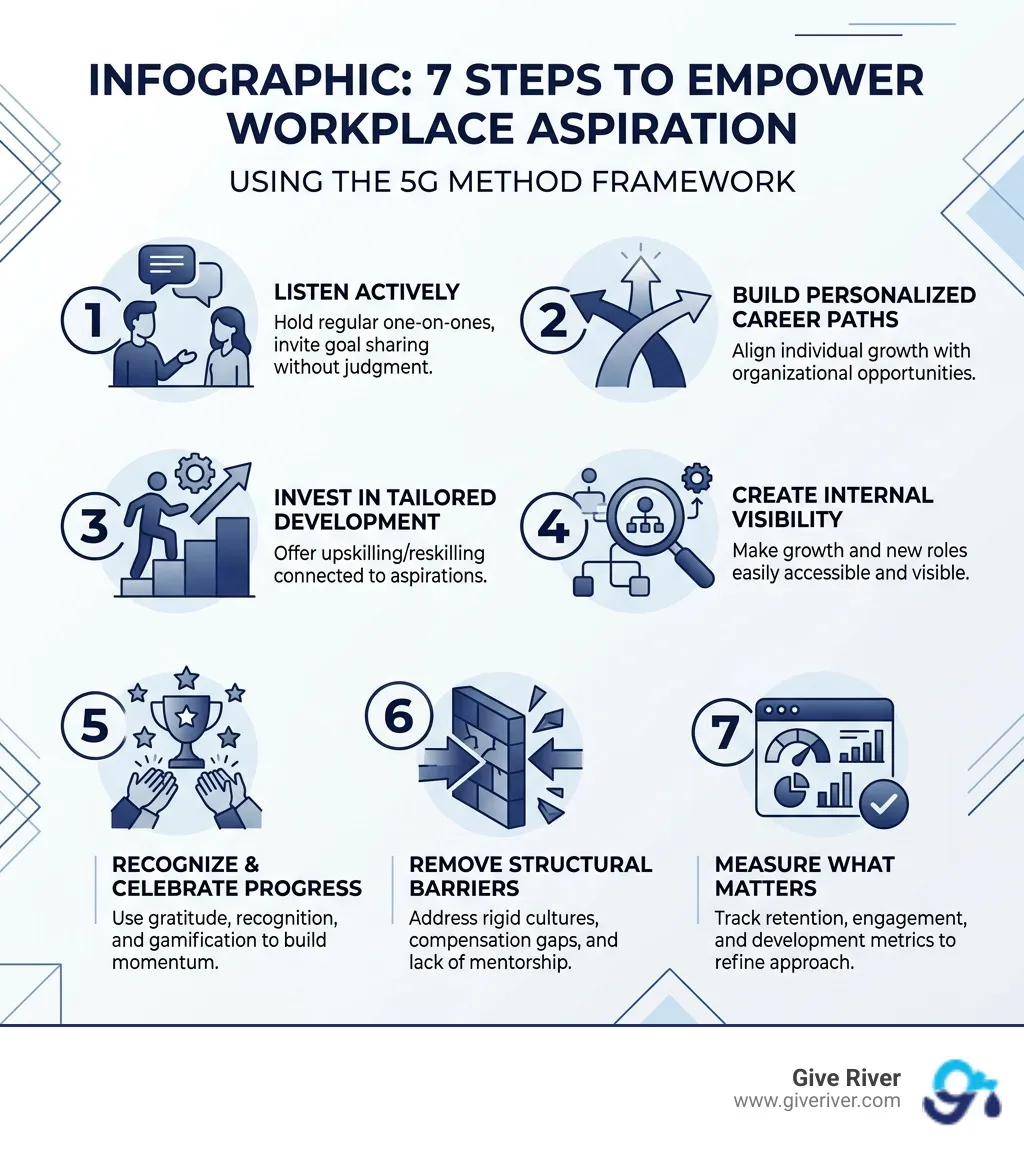
How to empower aspiration in the workplace:
- Listen actively — hold regular one-on-one meetings where employees can share career goals without judgment
- Build personalized career paths — align individual growth goals with organizational opportunities
- Invest in tailored development — offer upskilling and reskilling that connects to each person's aspirations, not just company needs
- Create internal visibility — make it easy for employees to see and pursue growth opportunities within the organization
- Recognize and celebrate progress — use gratitude, peer recognition, and gamification to reinforce momentum
- Remove structural barriers — address rigid cultures, compensation gaps, and lack of mentorship that quietly kill ambition
- Measure what matters — track retention, engagement, and development metrics to refine your approach over time
The numbers make the stakes clear. Only 15% of employees feel genuinely engaged at work — meaning the vast majority are showing up without a real emotional connection to what they do. At the same time, employees whose development aligns with their personal goals are 87% less likely to leave their roles. The gap between those two realities is exactly where aspiration lives.
Aspiration in the workplace is more than ambition or a desire for a corner office. It is the intrinsic motivation that drives people to grow, contribute meaningfully, and find genuine purpose in their work. As psychologist Abraham Maslow framed it, self-actualization — "the desire to become the most that one can be" — sits at the very top of human needs. When organizations ignore that need, they do not just lose productivity. They lose people.
What is striking is that the aspiration gap is not primarily a skills problem or even a compensation problem. It is a design problem. Most workplaces were never built to surface, support, and sustain what employees actually want to become.
I am Meghan Calhoun, Co-Founder of Give River and a workplace performance expert with over two decades of experience leading high-pressure teams across industries — from Fortune 100 sales to emotionally demanding frontline work — and everything I have learned about how to empower the aspiration in the workplace is built into the framework we will walk through together. Let us get into the strategies that actually move the needle.
Quick look at how to empower the aspiration in the workplace:
- advantages of career development programs
- career development programs
- career development mentoring programs
Strategies for How to Empower the Aspiration in the Workplace
Empowering aspiration isn't a "set it and forget it" HR policy; it’s a living part of your culture. To truly unlock potential, we have to move beyond generic "employee of the month" plaques and dive into the specific, individual dreams of our team members.
The Power of Active Listening and One-on-Ones

The foundation of how to empower the aspiration in the workplace starts with a simple, often overlooked skill: active listening. Many managers treat one-on-one meetings as status updates on tasks. To empower aspiration, these meetings must pivot toward the human being behind the desk.
We recommend leaders become "coaches" rather than "directors." This means asking open-ended questions like, "What projects have made you feel most energized lately?" or "Where do you see yourself contributing in two years?" When leaders show genuine interest in an employee's personal mission, it builds a bridge of trust. This trust is the only environment where an employee feels safe enough to voice an audacious goal.
Personalized Career Pathing and Internal Visibility
One-size-fits-all career ladders are relics of the past. Today’s workforce—especially as we navigate the landscape of April 2026—craves personalization. Organizations can support aspirations by creating personalized career paths that align individual skills with company objectives.
A major barrier to growth is often a lack of internal visibility. If an employee doesn't know that a lateral move into product marketing is possible, they might look for that opportunity at a competitor. By providing clear Learning and Development Solutions, you show your team that their future is right here.
Bridging the Gap with Mentorship and Skill Development
Aspiration without a roadmap is just a wish. To turn that "wish" into an achievement, we must provide the tools for the journey. This is where upskilling and reskilling become critical.
Research shows that 91% of employees seek personalized training. When development is tailored to an individual’s specific goals, they are significantly more motivated. It's not just about learning a new software; it's about professional fulfillment.
The Economic Impact of Growth
The data from the Bureau of Labor Statistics is clear: education and skill acquisition pay off. Individuals with a bachelor’s degree earn an average of $1,334 a week, compared to $809 for those with only a high school diploma. While degrees are one path, Professional Growth Programs within the workplace offer a more immediate way for employees to increase their value and realize their aspirations.
Mentorship plays a dual role here. It provides the "how-to" (the skills) and the "who-to" (the network). A mentor can act as a mirror, reflecting an employee's potential back to them and helping them navigate the "career maze" with fewer wrong turns.
Overcoming Barriers to Empower the Aspiration in the Workplace
We can't talk about aspiration without addressing what kills it. In 2026, we are seeing a shift in how people view the "top" of the corporate ladder. Only 30% of Americans express a desire to climb to C-suite roles. Instead, they are prioritizing financial security, job satisfaction, and work-life balance.
The Paycheck Paradox and Gen Z
We also have to face the "paycheck paradox." About 55% of Gen Z respondents feel undercompensated to extend themselves beyond their defined roles. If an employee is struggling with financial stress, they aren't thinking about "self-actualization"—they are thinking about rent.
To overcome this, organizations must:
- Align compensation with contribution: Ensure people feel the "extra mile" is worth the effort.
- Offer financial wellness: 44% of Americans want more one-on-one financial help from employers.
- Foster flexibility: Rigid cultures that ignore work-life balance are the fastest way to burn out a high-aspirant employee.
While platforms like Bonusly or Kudos focus heavily on the "gratitude" aspect of recognition through transactional point-swapping, Give River differentiates itself by addressing the whole employee. We believe you must also address the structural barriers—like career pathing and wellness—to keep the fire of aspiration burning. A well-crafted Employee Development Plan should address both the professional goals and the personal boundaries of the individual, something transactional platforms often overlook.
Setting and Pursuing Individual Career Goals
While the organization provides the soil, the employee must plant the seed. We encourage team members to take ownership of their journey through a Professional Growth Plan (PGP).
The SMART and SWOT Approach
- SMART Goals: Aspirations should be Specific, Measurable, Attainable, Realistic, and Time-bound. Instead of "I want to be a leader," try "I want to lead a cross-functional project by Q4."
- SWOT Analysis: Encourage employees to perform a personal SWOT (Strengths, Weaknesses, Opportunities, Threats) analysis. This builds self-efficacy—the belief in one's own ability to succeed.
By utilizing Professional Growth Tools, employees can track their progress and stay current in their industry. This continuous learning mindset ensures they are ready when opportunity knocks.
Measuring Success and Sustaining a Culture of Growth
How do you know if your efforts to how to empower the aspiration in the workplace are actually working? You can't manage what you don't measure.
Organizations that successfully foster aspirational cultures see a 21% increase in productivity and a 22% increase in profitability. But beyond the bottom line, look at your "Innovation Rates" and "Retention Metrics." Are your top performers staying? Are they bringing new ideas to the table?
We recommend using Employee Goal Tracking Software to monitor skill acquisition and role progression. However, don't ignore qualitative feedback. Regular stay interviews and engagement surveys can tell you more about the "soul" of your culture than a spreadsheet ever could.
How to Empower the Aspiration in the Workplace Through Recognition
Recognition is the fuel that keeps the engine of aspiration running. At Give River, we believe in the power of gratitude and gamification. When an employee takes a risk or learns a new skill, that effort needs to be seen.
Peer-to-peer rewards and gamified milestones turn the "slog" of professional development into an engaging experience. This isn't just about fun; it's about neurobiology. Achieving a milestone releases dopamine, which creates a feedback loop that encourages the employee to set the next, higher goal.
Our Modern Employee Recognition Program Guide outlines how to move from "transactional" rewards—the primary focus of platforms like Bonusly or Kudos—to "transformational" recognition that truly honors an individual's journey. By linking recognition to specific growth milestones and the 5G Method, Give River ensures that every "thank you" also serves as a step toward an employee's ultimate career aspiration.
Conclusion: Unlocking Potential with the 5G Method
Empowering aspiration is the ultimate win-win. The employee gains a sense of purpose and a path to their "best self," while the organization gains a loyal, high-performing, and innovative contributor.
At Give River, we've refined this process into our 5G Method:
- Guided: Providing the roadmap and mentorship needed for success.
- Gamified: Making the growth journey engaging and rewarding.
- Gratitude: Building a culture where every contribution is valued.
- Growth: Offering the content and tools for continuous professional and personal development.
- Generosity: Connecting workplace success to a larger community impact.
By integrating these elements, you create a purpose-driven workplace where potential isn't just a buzzword—it's a reality. If you're ready to transform your culture and see what your team is truly capable of, explore our Learning & Development Solutions today.
Let's stop just "managing" employees and start empowering their greatest aspirations. The future of your organization depends on it.
More from this category.

Understanding Workplace Culture
Improve workplace culture by focusing on key elements that lead to a more engaging and fulfilling work environment. Company culture isn't just an HR buzzword; it's the heartbeat of any thriving organization. It shapes how employees feel,…

Why Building a Strong Volunteer Culture Is Critical for Your Organization's Success
Creating a volunteer culture goes beyond filling positions; it's about cultivating an environment where volunteers feel valued, connected to your mission, and empowered to make a meaningful impact.

Why Top Companies Are Embracing Mindfulness
Mindfulness in workplace settings has evolved from a wellness trend to a business imperative. In today's demanding work environment, where 83% of American workers suffer from work-related stress and workplace stress costs businesses over…
See the platform in action.
Free for up to 25 members, or try Core or Growth free for 30 days. A card is required; Free is never charged, and a trial bills when it ends unless you cancel.