Why Remote Work Culture Building Is the Defining Leadership Challenge of 2026
Remote work culture building is the intentional process of designing values, communication norms, rituals, and connection systems that hold a distributed team together — replacing the organic culture that once formed naturally in hallways…

Remote work culture building is the intentional process of designing values, communication norms, rituals, and connection systems that hold a distributed team together — replacing the organic culture that once formed naturally in hallways and conference rooms.
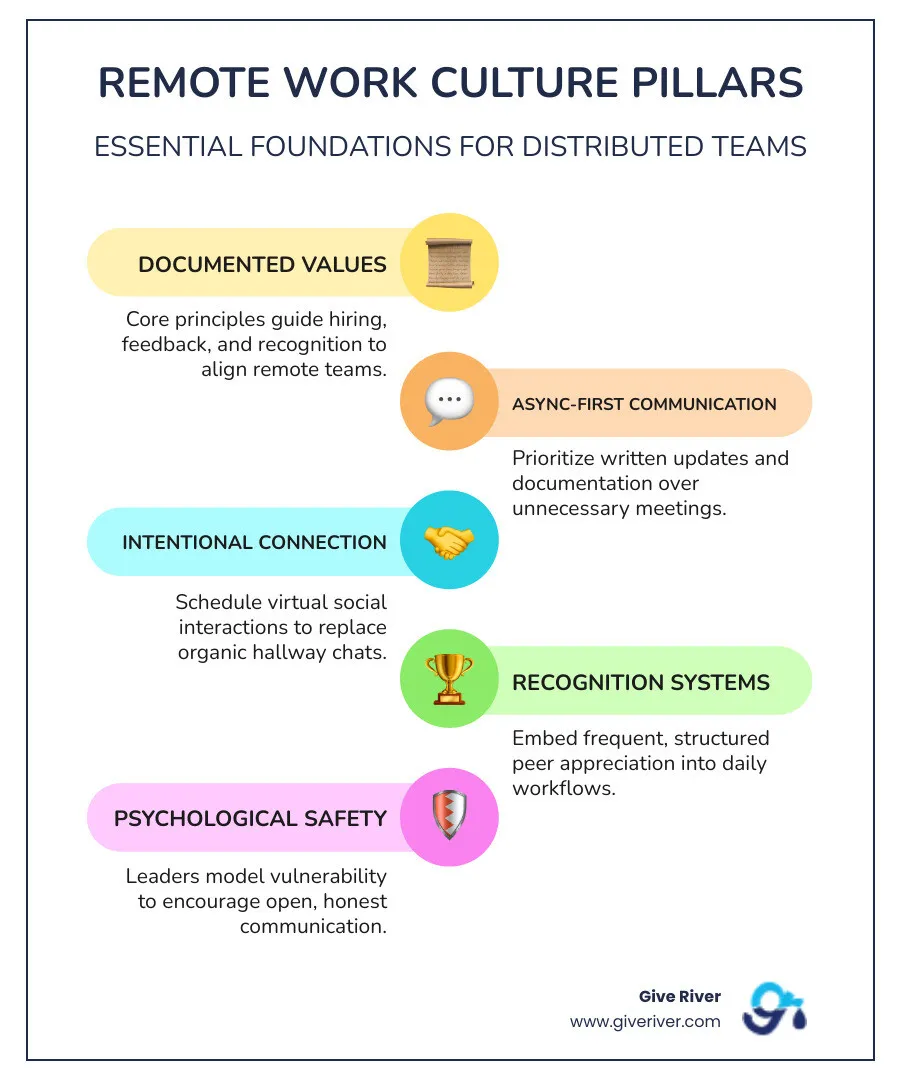
Here's a quick breakdown of what it takes to build a strong remote culture:
| Pillar | What It Means in Practice |
|---|---|
| Documented Values | Write down your core values and make them the foundation of hiring, feedback, and recognition |
| Async-First Communication | Default to asynchronous tools; use meetings only when truly necessary |
| Intentional Connection | Schedule virtual social time — it won't happen on its own |
| Recognition Systems | Build structured, frequent appreciation into daily workflows |
| Psychological Safety | Model vulnerability from the top so people feel safe speaking up |
| Wellness Boundaries | Protect focus time, enforce time off, and monitor for burnout signals |
The numbers tell a sobering story. Low employee engagement costs the global economy $8.8 trillion annually, according to Gallup research. Buffer's State of Remote Work report found that 15% of remote workers feel lonely, 11% lack motivation, and 14% struggle with time zone challenges — and that's before you factor in burnout. A separate study found that 43% of US desk workers feel burned out, with executives reporting a 20% drop in work-life balance over the past year alone.
And yet, the shift to distributed work isn't reversing. Fewer than one in five employers plan to return to pre-pandemic office setups. Remote and hybrid work is the environment you have — which means culture can no longer form by accident. It has to be designed.
Most organizations still treat remote culture as an afterthought — a Zoom happy hour here, a Slack emoji there. But research consistently shows that companies without a strong culture are significantly less effective at decision-making, collaboration, and innovation. The gap between teams that thrive remotely and those that quietly unravel comes down to one thing: intentionality.
I'm Meghan Calhoun, Co-Founder of Give River and a workplace wellness advocate with over two decades of experience leading high-pressure teams — experience that taught me how broken the traditional approach to performance and culture really is. Building Give River's 5G Method was born directly from that journey, and remote work culture building is at the heart of everything we help teams do. In the sections below, we'll walk through the core pillars, practical strategies, and measurable frameworks that turn a scattered remote team into a genuinely connected, high-performing one.
Discover more about remote work culture building:
The Core Pillars of Remote Work Culture Building
In a traditional office, culture is often "caught" rather than "taught." You overhear a senior leader handling a difficult client call, or you bond with a colleague over a shared hobby during lunch. In a remote environment, these organic moments disappear. We have to move from an accidental culture to an intentional culture.
Think of your culture as the "invisible operating system" of your company. It isn't the tools you use (like Slack or Zoom), but how you use them. It’s the set of unwritten rules that dictate how people behave when no one is watching.
| Accidental Culture (Office-Centric) | Intentional Culture (Remote-First) |
|---|---|
| Information spreads through "hallway talk" | Information is documented in a single source of truth |
| Trust is built by "seeing" people work | Trust is built through transparency and outcomes |
| Social connection happens spontaneously | Social connection is scheduled and prioritized |
| Leadership is based on charisma and presence | Leadership is based on support and clarity |
To succeed in 2026, we must adopt a leadership mindset that prioritizes trust over surveillance. Microsoft's 2022 Work Trend Index report revealed a massive "productivity paranoia": 87% of employees felt productive working remotely, yet only 12% of leaders were confident their teams remained productive. Closing this gap is the first step in building a sustainable culture.
Defining Values and Psychological Safety in Remote Work Culture Building
Values are the DNA of your organization. In a remote setting, they must be more than just posters on a (virtual) wall; they must be documented and lived. When we talk about organizational culture in virtual teams, we are really talking about how well those values are adhered to when the team is spread across time zones.
One of the most effective ways to ensure values alignment is to hire for values fit rather than "culture fit." Culture fit often leads to hiring people who look and act like the existing team, which can stifle diversity. Values fit, however, ensures that everyone shares the same core principles — like "transparency," "ownership," or "generosity" — regardless of their background.
Psychological safety is the other half of this equation. It is the belief that you won't be punished or humiliated for speaking up with ideas, questions, concerns, or mistakes. In a remote team, where you can't see body language easily, leaders must work twice as hard to foster this. This starts with modeling vulnerability. When a leader admits they are struggling with a project or shares a personal challenge, it gives the rest of the team permission to be human, too.
Mastering Asynchronous Communication and Transparency
The quickest way to burn out a remote team is to treat a digital workspace like a physical one. If you expect instant replies to every Slack message, you are effectively preventing your team from doing "deep work."
We advocate for an async-first approach. This means defaulting to written communication, recorded videos (like Loom), or shared documents, and reserving synchronous meetings for complex problem-solving or emotional connection.
A "single source of truth" is essential. Whether you use Notion, Confluence, or a company handbook like GitLab’s, every policy, process, and decision should be documented. This levels the playing field for team members in different time zones and reduces the "meeting overload" that plagues so many distributed teams.
Before scheduling a meeting, ask: Could this be an email or a recorded update? If the answer is yes, cancel the meeting. Your team’s focus time is their most valuable asset.
Fostering Connection Through Virtual Community Building
Loneliness is one of the biggest threats to remote work sustainability. Without the "watercooler," we have to be creative about virtual community building.
We recommend building "structured social time" into the week. This isn't about forced fun; it's about creating space for human connection. Some effective methods include:
- The Swedish Fika: A 15-to-30-minute informal coffee break where work talk is strictly forbidden.
- Social Channels: Create Slack or Teams channels dedicated to non-work topics like #pets, #cooking, or #book-club.
- Virtual Watercoolers: Open a recurring Zoom link for an hour a day where people can "drop in" to work silently together or chat, mimicking the feel of a shared office space.
By making connection a formal part of the schedule, you signal that building relationships is just as important as hitting KPIs.
Practical Strategies and Measuring Remote Work Culture Building
Building a culture is a marathon, not a sprint. It requires long-term evolution and a commitment to organizational resilience. You need frameworks that don't just look good on paper but actually change the daily experience of your employees.

Implementing Recognition and Rewards for Remote Teams
In an office, you might give a teammate a high-five or a quick "great job" after a presentation. Remotely, those small wins often go unnoticed, which can lead to a sense of invisibility. Integrated recognition is the antidote.
According to O.C. Tanner’s 2023 Global Culture Study, integrated recognition increases the odds of a thriving workplace culture by a staggering 646%. We suggest implementing peer-to-peer kudos systems where team members can publicly thank each other for their contributions.
While platforms like Bonusly or Kudos are popular for micro-rewards, they often focus on transactional points and gift cards. Give River differs by integrating recognition into a holistic wellness framework—our 5G Method—ensuring appreciation isn't just a perk, but a core part of your "Gratitude" pillar that drives long-term fulfillment. At Give River, we believe recognition should be more than a digital currency; it should be a visible, sincere part of your team's DNA. Whether it’s a dedicated #shout-out channel or a "Say Thanks" segment at the start of every all-hands meeting, making appreciation visible is vital. For more ideas, check out our remote team engagement tips.
Promoting Wellness and Preventing Burnout Remotely
When your home is your office, the lines between work and life blur. It’s no surprise that 9% of remote workers find themselves working more than they did in an office. As leaders, we have a responsibility to protect our team's mental health.
This starts with setting clear boundaries. We encourage teams to:
- Normalize logging off: Leaders should avoid sending emails or messages after hours. If you must work late, use the "schedule send" feature so your team isn't interrupted during their personal time.
- Enforce focus time: Encourage "No Meeting Fridays" or daily blocks of time where notifications are turned off.
- Monitor for burnout: Watch for signs like decreased participation, unusual irritability, or a drop in work quality.
Gallup research shows that having a job you hate is actually worse for your health than being unemployed. A culture of wellness isn't just about "perks"; it's about respecting the human being behind the screen.
Measuring Success in Remote Work Culture Building
How do you know if your hybrid work team building efforts are actually working? You can't manage what you don't measure.
We recommend tracking a mix of quantitative and qualitative metrics:
- eNPS (Employee Net Promoter Score): How likely are your employees to recommend your company as a great place to work?
- Retention Rates: Are people staying, or are you losing talent to competitors with better remote setups?
- Internal Mobility: Are remote workers being promoted at the same rate as those who might be closer to leadership?
- Pulse Surveys: Short, frequent surveys can help you catch cultural "rot" before it becomes a crisis.
At Give River, we use our 5G Method (Guided, Gamified, Gratitude, Growth, and Generosity) to provide a comprehensive framework for fulfillment. By focusing on these five areas, you create a culture that isn't just productive, but truly meaningful.
If you're looking for a structured way to bring these elements to life, our team building solutions are designed specifically to bridge the gap between distributed employees.
Common Mistakes to Avoid
Even with the best intentions, it's easy to stumble. Here are the most common pitfalls we see in remote work culture building:
- Micromanagement: Trying to track every mouse movement or requiring cameras to be on 100% of the time destroys trust. Focus on outcomes, not activity.
- Treating Remote as "Lesser": If you have a hybrid team, ensure that those working from home have the same access to information and opportunities as those in the office. If one person is remote, everyone should act as if they are remote.
- Forced Fun: Zoom happy hours after a long day of Zoom meetings are often the last thing people want. Make social activities optional and varied.
- Ignoring Time Zones: Scheduling all-hands meetings that require some team members to wake up at 3:00 AM is a quick way to breed resentment. Rotate meeting times to share the burden fairly.
Conclusion: Sustaining Culture for the Long Term
Building a sustainable remote culture isn't a "one-and-done" project. It is a living, breathing part of your organization that requires constant nurturing and iteration. As we move further into 2026, the companies that thrive won't be the ones with the fanciest offices, but the ones that have mastered the art of digital connection.
By focusing on documented values, async-first communication, and genuine gratitude, you can create a workplace where people feel seen, heard, and valued—no matter where in the world they are sitting.
Ready to transform your team's culture? Let's build something great together.
Key Takeaways for Your Remote Strategy:
- Intentionality is everything: Culture doesn't happen by accident in a remote setting; you have to design it.
- Trust is the foundation: Move away from surveillance and toward outcome-based management.
- Documentation is your friend: Create a single source of truth to ensure everyone has equal access to information.
- Prioritize the human: Use recognition, wellness boundaries, and structured social time to fight isolation and burnout.
- Measure and iterate: Use pulse surveys and eNPS to track your progress and adjust your strategy.
More from this category.

Understanding Workplace Culture
Improve workplace culture by focusing on key elements that lead to a more engaging and fulfilling work environment. Company culture isn't just an HR buzzword; it's the heartbeat of any thriving organization. It shapes how employees feel,…
Why Building a Strong Volunteer Culture Is Critical for Your Organization's Success
Creating a volunteer culture goes beyond filling positions; it's about cultivating an environment where volunteers feel valued, connected to your mission, and empowered to make a meaningful impact.

Why Workplace Aspiration Is the Missing Link in Employee Engagement
Knowing how to empower the aspiration in the workplace is one of the most high-leverage things a leader or HR professional can do in 2026 — and most organizations are still getting it wrong.
See the platform in action.
Free for up to 25 members, or try Core or Growth free for 30 days. A card is required; Free is never charged, and a trial bills when it ends unless you cancel.