Why Virtual Leadership Development Is Now a Business-Critical Priority
Virtual leadership development has moved from a pandemic-era workaround to one of the most powerful tools organizations have for building capable, future-ready leaders — at scale, across time zones, and without the logistical costs of…

Virtual leadership development has moved from a pandemic-era workaround to one of the most powerful tools organizations have for building capable, future-ready leaders — at scale, across time zones, and without the logistical costs of pulling people out of the field.
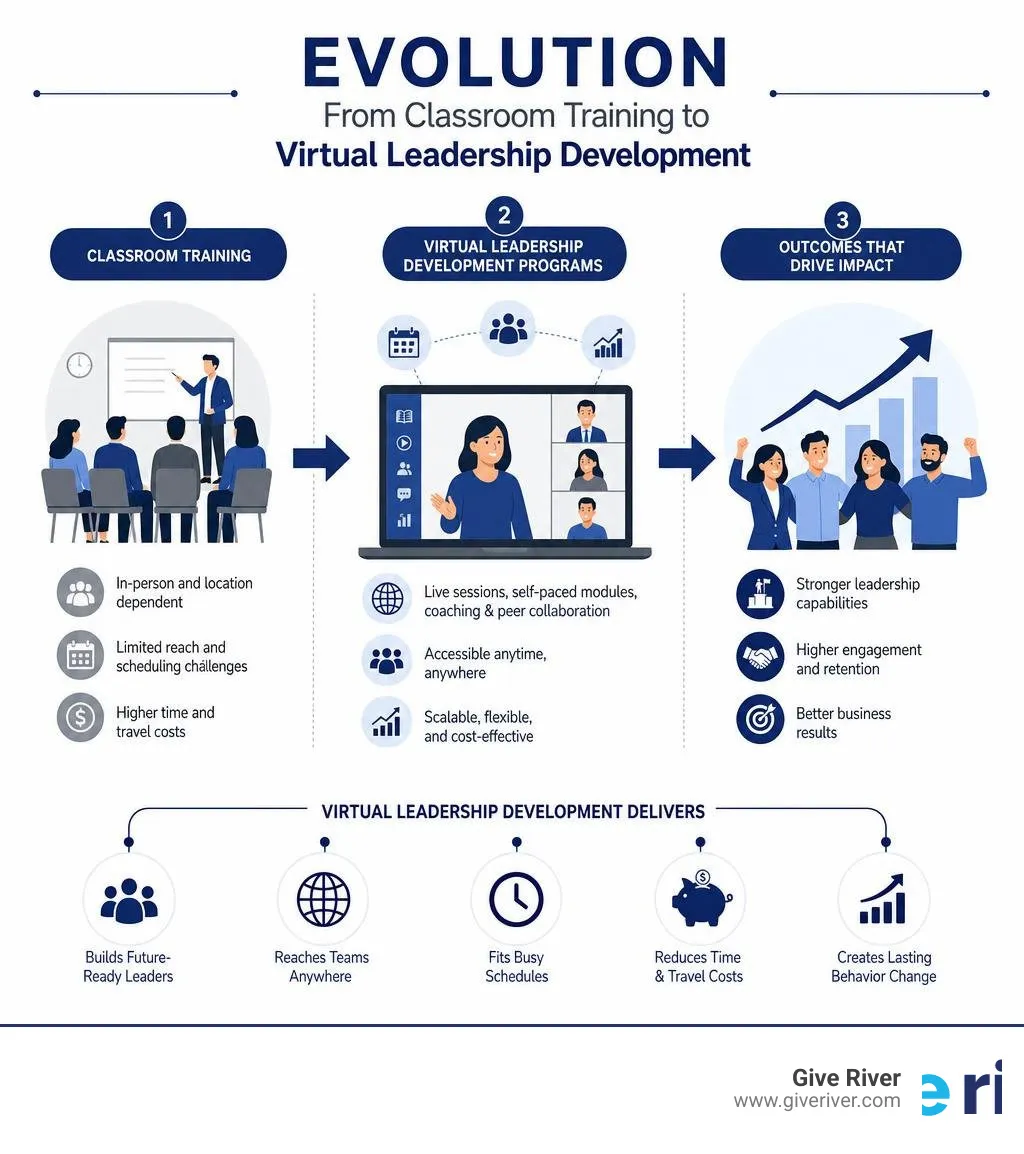
What is virtual leadership development? Here's a quick breakdown:
| Aspect | What You Need to Know |
|---|---|
| Definition | Structured programs that build leadership skills through online formats — live sessions, self-paced modules, coaching, and peer collaboration |
| Typical duration | 12-13 weeks, with 3-6 hours of commitment per week |
| Key formats | Live virtual classrooms, asynchronous learning, blended cohort programs |
| Core skills developed | Communication, emotional intelligence, change agility, coaching mindset, influencing without authority |
| Proven outcomes | 31% of participants receive promotions post-program; 93% develop skills aligned with organizational capabilities |
| Best for | Mid-sized to large organizations building leadership pipelines across remote, hybrid, or distributed teams |
The numbers tell a compelling story. Research from virtual leadership programs in healthcare settings found that 96% of participants would recommend the program to others, and 83% of supervisors observed their employees actively applying new skills after completion. Meanwhile, companies that invest in high-quality development opportunities are 3.4x more likely to be rated a best place to work.
Yet despite this evidence, many organizations are still treating leadership development as an in-person-only endeavor — or worse, skipping it entirely. The result is a widening leadership capability gap that shows up as disengaged teams, stalled promotions, and a succession planning crisis. Over 50% of CEOs currently lack any formal succession plan.
The shift to virtual formats isn't just about convenience. It's about closing that gap faster, more equitably, and more affordably than traditional classroom training ever could.
I'm Meghan Calhoun, co-founder of Give River and a workplace wellness strategist with over two decades of experience driving performance in high-pressure environments — experience that directly informs how I think about virtual leadership development as a tool for sustainable team growth. In the sections ahead, I'll walk you through exactly how to design, scale, and measure virtual leadership programs that create real behavior change — not just better survey scores.
Handy virtual leadership development terms:
Designing an Effective Virtual Leadership Development Program

To design a high-impact program, we must first understand what makes virtual formats uniquely effective. Unlike traditional, off-site workshops where managers are flooded with information over two days and then return to a mountain of unanswered emails, virtual programs leverage "spaced learning." This approach spreads training over several weeks, allowing participants to learn a concept, apply it in real time, and reflect on the outcome.
The most successful programs combine three core pillars:
- Asynchronous Spaced Learning: Self-paced modules, readings, and videos that participants complete on their own schedule (typically 3-5 hours weekly).
- Synchronous Blended Learning: Live, interactive virtual classrooms where cohorts meet to discuss case studies, participate in role-playing, and align on goals.
- Action Learning: Real-world projects where leaders apply their new skills directly to current organizational challenges, ensuring immediate business impact.
To maximize retention, we recommend organizing participants into 12-week cohorts of 4 to 10 people. This structure builds a tight-knit community while remaining highly manageable for busy professionals. By integrating these cohorts into your broader strategy for Professional Development in Business, you create a continuous pipeline of prepared leaders.
Virtual vs. In-Person Leadership Training
| Feature | Virtual Leadership Programs | Traditional In-Person Training |
|---|---|---|
| Logistics & Cost | Low; no travel, venue, or lodging expenses. | High; requires travel, physical space, and catering. |
| Learning Model | Spaced learning (weeks of bite-sized application). | Block learning (1-3 consecutive full days). |
| Work Interruption | Minimal; fits into the weekly flow of work. | High; takes leaders entirely away from daily tasks. |
| Scalability | High; can reach thousands of global employees. | Low; limited by classroom size and geographic location. |
| Peer Connections | Broad; builds cross-functional, global networks. | Deep but localized; limited to those in the room. |
The Core Competencies of Virtual Leadership Development
Leading in a distributed environment requires a distinct shift in mindset. We must move away from old-school "command and control" management and embrace a modern coaching approach. Through virtual leadership development, we help managers build these critical modern competencies:
- A Coaching Mindset: 97% of participants in structured virtual programs learn to successfully differentiate between managing (telling people what to do) and coaching (asking powerful questions to unlock potential).
- Emotional Intelligence & Mindfulness: Virtual leaders must develop heightened self-awareness to read between the lines of digital communication and manage their own stress.
- Change Agility: The ability to guide teams through rapid organizational shifts with confidence and clarity.
- Influencing Without Authority: Learning to build trust and drive alignment across cross-functional, remote teams where direct reporting lines do not exist.
- The Communication Audit: Teaching leaders to assess how information flows within their teams, optimizing both real-time and asynchronous channels.
By focusing on these human-centered capabilities, you provide the essential Professional Development for Employees that directly impacts daily team performance.
Overcoming the Challenges of Virtual Leadership Development
While the benefits are clear, virtual training comes with its own set of hurdles. The most common is "Zoom fatigue" - the mental exhaustion that comes from back-to-back video calls. We can combat this by keeping live sessions highly interactive, limiting them to 90 minutes, and incorporating gamified elements.
Another major challenge is the lack of physical observation. In a physical office, a manager can easily spot a team member who looks stressed or disengaged. In a remote setup, those visual cues disappear.
To bridge this gap, leaders must shift from observation-based insights to inquiry-based insights. Instead of waiting to notice a problem, leaders learn to create intentional check-ins. You can practice these skills in low-stakes environments using interactive Leadership Zoom Activities and collaborative Leadership Games Online to build authentic connections virtually.
The Role of Assessments, Coaching, and Peer Interaction
A successful virtual program is never just a collection of pre-recorded videos. To drive lasting behavior change, we must integrate personalized assessments, professional coaching, and structured peer interaction.
360-degree assessment -> 1:1 executive coaching -> peer dyad activities -> real-world practice
- The 360-Degree Leadership Survey: Before the program begins, participants gather feedback from peers, direct reports, and supervisors to identify blind spots.
- Executive Coaching: Over the course of the program, leaders participate in private, 90-minute coaching sessions to translate their 360-degree feedback into a personalized action plan.
- Peer Learning Groups & Dyads: Participants are paired up for "dyad activities" - short, recurring peer-to-peer check-ins to discuss homework and share challenges.
These elements ensure that learning is not isolated. By leveraging Team Building Activities for the Remote Workplace and executing targeted Remote Team Engagement Tips, organizations can foster deep, supportive networks that survive long after the formal training program ends.
Driving Organizational Goals and Succession Planning
Leadership development is not just an individual perk; it is a strategic business driver. Well-structured programs can lead to a 20% improvement in job performance and boost overall organizational outcomes by up to 25%.
Furthermore, virtual programs are a lifesaver for succession planning. With over half of CEOs lacking a clear transition plan, organizations face massive risks when key leaders depart. By making training accessible online, we can democratize leadership development, preparing mid-level and frontline managers to step into senior roles. This proactive approach directly supports Employee Engagement and Retention, ensuring high-potential talent sees a clear, supportive path forward. To design these pathways effectively, refer to our comprehensive Employee Engagement Experience Guide.
Best Practices for Engagement and Behavior Change

How do we ensure that what is learned in a virtual classroom actually gets applied on Monday morning? We focus on practical, actionable frameworks that leaders can use immediately:
- Micro-learning: Delivering training in bite-sized, 10-minute daily exercises rather than overwhelming half-day lectures.
- Stay Interviews: Teaching managers how to conduct proactive conversations with team members to understand what keeps them at the company and what might make them leave.
- The Burnout Stoplight Exercise: A simple weekly check-in where team members mark their stress levels as Green (good), Yellow (cruising but tired), or Red (at risk of burnout).
- Rose, Bud, Thorn Activity: A quick, structured team-building exercise where members share a recent success (rose), an upcoming opportunity (bud), and a current challenge (thorn).
For more ways to keep your remote teams connected, check out our guide on Strategies for Employee Engagement and the Employee Engagement Strategies Guide 2024.
How to Scale and Measure Your Virtual Leadership Training
Scaling virtual leadership development across an entire organization requires a platform that balances structured learning with daily, sustainable habits.
How Give River Compares to Traditional Platforms
When looking to scale leadership development, organizations often confuse simple recognition tools with comprehensive growth platforms. Here is how Give River compares to popular alternatives:
- Bonusly & Kudos: These platforms excel at peer-to-peer recognition and social shoutouts. However, they lack structured learning pathways, leadership coaching integration, and the systematic skill-building required for long-term succession planning.
- Give River: Instead of just celebrating daily tasks, we connect recognition directly to professional development. Through our unique 5G Method, we integrate five core pillars to build happier, healthier, and higher-performing teams:
- Guided: We provide clear, structured learning paths to help employees master new skills step-by-step.
- Gamified: We turn professional development into an engaging experience with challenges, milestones, and achievements.
- Gratitude: We celebrate the wins—both big and small—with integrated peer and manager recognition.
- Growth: We focus on continuous personal and professional development, ensuring your leaders are always learning.
- Generosity: We connect workplace achievements to real-world social impact, giving teams a shared sense of purpose.
Tracking Your ROI
To justify your investment and ensure long-term success, you must measure the impact of your program. We recommend tracking these key performance indicators (KPIs):
- Promotion Rates: Aim for a target similar to our benchmark of 31% of participants receiving promotions post-program.
- Skill Alignment: Measure the percentage of participants whose new skills align directly with your core organizational capabilities (targeting 90%+).
- Supervisor Application Rate: Survey supervisors to confirm that leaders are actively applying their training on the job (targeting 80%+).
- Retention & Culture: Track your progress toward becoming a top employer; organizations with high-quality development are 3.4x more likely to be rated a best place to work.
By combining modern virtual training design with a comprehensive engagement platform, you can scale your leadership development seamlessly. Ready to build a stronger, more connected leadership pipeline? Explore our tailored Team Building Solutions and let's start growing your leaders today.
More from this category.

The 5 Best Employee Engagement Platforms in 2026, Compared
Give River, Culture Amp, WorkTango, Engagedly, and Kudos compared from each vendor's own site: pricing, gamification, learning, surveys, and who each one fits.

Employee Engagement Software for Companies With 50–200 Employees (2026)
What a 50–200 person company needs from engagement software, what six platforms cost at that size, who each fits, and how fast you can launch.
What Is a Digital Engagement Platform? (And Why It Matters Right Now)
Understanding the digital engagement platform definition starts with a simple idea: it's a technology framework that centralizes how an organization communicates with, supports, and motivates its people — employees or customers — across…
See the platform in action.
Free for up to 25 members, or try Core or Growth free for 30 days. A card is required; Free is never charged, and a trial bills when it ends unless you cancel.